Friday, September 6, 2024

Napoleon Restored the Revolution of 1789

The notion that Napoleon’s 18 Brumaire Coup represented the complete undoing of everything the French Revolution fought for is the greatest misnomer in all Historical Discourse.

The radical even by modern standards political visions of the Girondins, Colliders, Jacobins and Enrages had already been dead for years but were themselves the product of the Revolution moving beyond its original stated goal.  After half a decade of rule by the Centrists devoid of any real political vision Napoleon was supported by multiple key leaders of the original Revolution.  

Emmanuel Joseph Sieyes was the original ideological leader of the Revolution, his “What is the Third Estate” was the Declaration of Independence of the Bourgeoisie.  He had faded into the background when the Revolution was radicalized and then became a vital backer of Napoleon’s Coup.

Of course he and a lot of the well known spokesmen of Bourgeoisie ideology were not strictly speaking of the Bourgeoisie themselves.  Someone who was would be Claude Perier who played an overlooked material role in starting the Revolution in 1789, was not fond of the Radicalism of 1792-94 and then was another vital backer of Napoleon and was among the founders of the Bank of France.

Even when Napoleon later became Emperor he was embodying the Pre-Revolution Philsophe concept of the Enlightened Monarch.

This is the problem I have with Peter Coffin’s “Leftism is the Left Wing of Capitalism” nonsense.  The French Revolution started and ended as a Bourgeoisie Revolution because of its Right Wing.

The Enrages were Proto Marxist-Leninists and the Conspiracy of the Equals were proto Libertarian Socialists.  The Girdondins may not have been Socialist enough to fit an official definition but they would have been enough for the CIA to overthrow them in a Coup during the Cold War with their calls for Agrarian Land Redistribution.

Sunday, September 1, 2024

Am I a Marxist?

Marxism is strictly speaking not a Socio-Economic or Political Ideology but a way of looking at History.  That can have implications on how one looks towards achieving their political goals, but you can in theory agree with a Marxist analysis of history while having politics that are the opposite of Marx’s.  And you can in turn have the same political goals as those who call themselves Marxists politically while rejecting a Marxist analysis of history.

At its broadest most basic sense Marxism is viewing history as primarily driven by Class Conflict and Material Conditions.  And in that I am essentially Marxist.  And my political goals are also the same, I am a Communist who desires a Moneyless, Classless Stateless Society.

However I view a lot of the specifics of how Marx and Engels framed their History of Class Conflict as gravely mistaken or at least outdated, which many contemporary Marxists and especially MLs still cling to dogmatically.  The division of eras simplistically into Primitive-Communism then “Slavery” then “Feudalism” then Capitalism being where we are now is very problematic in how biased towards a Western Perspective it is.  But even within that Western Perspective is still an oversimplification and tied to now outdated terminology.  The Socio-Economic Mode of Production of the Middle Ages is better defined as Manorialism not “Feudalism” for one example.

I have prior posts on this Blog already talking about aspects of all that.  But for further understanding of how wrong both the Marxist and common Liberal understanding of “Feudalism” and the Middle Ages is I recommend reading the book Those Terrible Middle Ages Debunking The Myths by Regine Pernoud and/or watching the YouTube videos on this Playlist I made.

Marxism is an Apostate child of Hegelianism.  Hegelianism was all about viewing History as driven by Conflicts, New Atheists are very Hegleian in their devotion to the discredited Science vs Religion Conflict thesis.  But I say Apostate because while keeping a form of Conflict in his view of History Marx also rejected the Idealism that Hegel inherited from Kant and Plato preferring to see things Materialistically like an Empiricist or Epicurean or Aristotelian or Stoic.  But Marx and Engels were not the first Materialist Worker focused Socialists, before them came Flora Tristan and Moses Hess.

TIK ignores the ways in which Marx Apostatized from Hegelianism in building his little Ideological Genealogy.  He recognized Aristotelianism as ultimately independent of Platonism in-spite of how Aristotle started as a student of Plato, well Marx is to Hegel as Aristotle was to Plato.

However the Marxists have brought this on themselves by not rejecting all the Hegelian terminology they should have.  “Dialectical Materialism” is an Oxymoron, Dialectics is definitionally an idealist concept having its roots in Pythagorean Dualism.  It no longer means what it originally meant in how Marx and Engels use the word, but modern Marxists fall right back into Hegelian Idealism for example in how Slavoj Zizek refuses to see a third option existing for anything including Gender.

Friday, August 2, 2024

Being a Communist and being a Zionist on the Internet are very similar.

I can explain how I'm a Communist because I believe in Collective Ownership of the means of production while working towards the goal of a Moneyless, Classless, Stateless Society.  Or that I’m a Zionist because I support the Jewish People's right to self determination in their Ancient Homeland.  And for every response that does attempt to engage with what I said I support there are far more that just go “look at the obviously evil things done by this Nation-State” which has nothing to do with those principals.

So let me make myself clear, I am no apologist for all the actions of the State of Israel especially not recently, or of Modern China or North Korea or the Soviet Union for most of its history.  Now Cuba, Vietnam and Laos I do think are reasonably successful Communist experiments, but they aren’t hills I’m willing to die on either.

Many calling themselves Anti-Zionist have had what Zionism means defined for them by bad faith actors.  The reverse also happens of course, I know most American Leftist self professed Anti-Zionists do not advocate the forced removal of the Jewish population currently living there.  However they refuse to face the material reality that the dominant factions in the Palestinian Authority do want that. 

If you support a Binational State where Jews and Arabs and other residents all have equal Citizenship and you're a Communist, then you basically have the same final goal as the founders of Labour Zionism like Aaron David Gordon and Ber Borochov.  At a certain point the disagreement becomes a matter of semantics, whether the Binational State should be called Israel or Palestine. But I think the supposed Anti-Colonialists should stop wanting to be named after what Hadrian called the region.  And plenty call themselves Zionsits while still supporting a Two State Solution.

Also as an American Citizen I firmly oppose the U.S. getting involved in any Middle East conflict on either side, in any way, either Military or Financially.

Even if a given Nation-State’s ruling ideology has no significant differences on paper from the specific form of Communism or Zionism I espouse, that would still not make every action that State took a reflection of the ideology.

However, that's not the case.  I’m a Labour-Zionist, and yes a lot of Israeli Prime Ministers were too, but their Labour party was diluted not unlike the British Labor Party.  Israel isn’t the only Capitalist State to ever have nominally Socialist Prime Ministers, even Japan had one briefly in the mid 90s.  But now Israel has for nearly 30 years been dominated by Likud, the Israeli equivalent of the LDP, an Authoritarian Socially Conservative and Economically Capitalist Party.

And with Communism every Communist State has been not just specifically Marxist but more specifically Leninist.  Lenin was actually already controversial within Marxism, both in Russia and outside of it, before even the 1905 Russian Revolution happened.  So no Bolshevism didn’t become what makes it distinct from other Marxisms as a result of being a ruling party.  Rosa Luxemburg predicted why Lenin’s Vanguardism would prove inherently corrupt and what happened vindicated her completely.  

One of her main points was the innate spontaneity of a true Popular Revolution, something Lenin refused to accept after the February Revolution spreading conspiracy theories that it was an Allied plot (his "Revolutionary Defeatism” was always just an excuse for siding with the Central Powers, he was no true Pacifist).

Another of her main points was about Bureaucracy, which Lenin mocked people for being concerned about.  This is why Trotskyism, as sympathetic to Trotskyists as I sometimes am also fails, you can’t pretend you are rejecting only Stalin not Lenin when Lenin mocked you in advance.

I don’t claim to have all the answers to figure out how to do either Communism or Zionism correctly.  But I do know good Zionism needs to also respect the right to self determination of the other people living west of the Jordan.  And any desire to expand Israel’s border East of the Jordan is unacceptable.

Monday, July 15, 2024

Soul Sleep and Christian Mortalism are not the same

And yet they’re stuck sharing the same Wikipedia Page.

Soul Sleep and believing the Soul is just as dead as the body between physical death and physical resurrection have a lot in common, both reject the Platonist/Pythagorean/Essene/Origenist view of The Soul that has become the mainstream popular view. One definitely does and the other still could involve a lack of any concise state between death and resurrection.  

But Soul Sleep allows more wiggle room, it could allow Souls in Sheol/Hades/The Grave to be in a sort of Dreamlike state, same with the Martyrs under the Altar in the Throne Room in Revelation 6 at the 5th Seal and later washing their robes in chapter 7.  Which gives me flexibility in how to deal with passages that seem to imply a pre-resurrection afterlife.

But more importantly the idea that the Soul is just dead is what Annihilationists tend to believe.

What Jesus says in Matthew 10:28 is important here.
“And fear not them which kill the body, but are not able to kill the soul: but rather fear him which is able to destroy both soul and body in hell.”
Annihilationists like Lex Meyer seem to think this verse proves their position even though it contradicts it.  If the Soul simply dies when the body dies then anyone who can kill the body can kill the Soul.  Instead killing the Soul is something only God can do, and Jesus goes on to assure us God never would do that.  And in John 11:26 Jesus promises us that we will NEVER die.

The New Testament refers to the dead as asleep multiple times.  That’s why I consider Soul Sleep the face value Biblical View and the burden of proof is on those who reject it.  And the verses they most cling to I've already addressed here.

It’s also the most ancient traditional view being implied in Justin Martyr and explicitly taught by Athenagoras.  It was also the View of the Smyrna-Lyon tradition of Polycarp-Irenaeus and possibly compatible with what Tertullian taught.  Some who actually believe in Soul Sleep may have unwittingly used more Mortalism based language, so I remain unsure what to think of Tatian, Octavius or Marcus Minucius Felix.

The fact that so many mainstream Christians now treat Soul Sleep as a damnable heresy shows how far we’ve fallen into Platonist Error.

Soul Mortalism is still closer to the Biblical Truth then the mainstream view, but I do want the difference to be known as well as that Soul Sleep is where I stand.

Update October 22nd 2024: This Article by a John Anderson provides a large list of times The Dead are referred to as Asleep.

That Author probably holds other Beliefs I disagree with, I haven't read the entire website and even in this article takes the ill advised tactic of quoting Ecclesiastes at face value, and clearly doesn't seem to believe in Universal Salvation.  But regardless it's a good resource.

So I'm gonna copy/Paste the list of Verses from that article here, he doesn't say which Translation he used but I'm confident the KJV agrees with all of these..

Deuteronomy 31:16: “The Lord said to Moses, Behold, thou shalt sleep with thy fathers.”

II Samuel 7:12:  “When thy days be fulfilled, and thou shalt sleep with thy fathers.""

I Kings 1:21:  “When my lord the king shall sleep with his fathers.”

I Kings 2:10:  “David slept with his fathers.”

I Kings 11:21:  “David slept with his fathers.”

I Kings 11:43:  “Solomon slept with his fathers.”

I Kings 14:20: “Jeroboam...slept with his fathers.”

I Kings 14:31:  “Rehoboam slept with his fathers.”

I Kings 15:8: “Abijam slept with his fathers.”

I Kings 15:24:  “Asa slept with his fathers.”

I Kings 16:6:  “Baasha slept with his fathers.”

I Kings 16:28:  “Omri slept with his fathers.”

I Kings 22:40:  “Ahab slept with his fathers.”

I Kings 22:50:  “Jehoshaphat slept with his fathers.”

II Kings 8:24:  “Joram slept with his fathers”

II Kings 10:35:  “Jehu slept with his fathers”

II Kings 13:9:  “Jehoahaz slept with his fathers”

II Kings 13:13:  “Joash slept with his fathers”

II Kings 14:16:  “Jehoash slept with his fathers”

II Kings 14:22:  “The king slept with his fathers”

II Kings 14:29:  “Jeroboam slept with his fathers”

II Kings 15:7:  “Azariah slept with his fathers”

II Kings 15:22: “Menahem slept with his fathers”

II Kings 15:38:  “Jotham slept with his fathers”

II Kings 16:20:   “Ahaz slept with his fathers”

II Kings 20:21:  “Hezekiah slept with his fathers”

II Kings 21: 18:  “Manasseh slept with his fathers”

II Kings  24:6:  “Jehoiakim slept with his fathers”

II Chron. 9:31:  “Solomon slept with his fathers”

II Chron. 12:16:  “Rehoaboam slept with his fathers”

II Chron. 14:1:  “Abijah slept with his fathers”

II Chron. 16:13:  “Asa slept with his fathers”

II Chron. 21:1:  “Jehoshaphat slept with his fathers”

II Chron. 26:2:  “The king slept with his fathers”

II Chron. 26:23:  “Uzziah slept with his fathers”

II Chron. 27:9:   “Jotham slept with his fathers”

II Chron. 28:27:  “Ahaz slept with his fathers”

II Chron. 32:33:  “Hezekiah slept with his fathers”

II Chron. 33:20:  “Manasseh slept with his fathers”

Job 7:21:  “Now shall I sleep in the dust”

Job 14:12:  “They shall not awake, nor be raised out of their sleep”

Psalm 13:3:  “Lest I sleep the sleep of death”

Psalm 90:5:  “Thou carriest them away as with a flood; they are as a sleep”

Psalm 146:4  “His breath goeth forth, he returneth to his earth; in that very day his thoughts perish.” 

Daniel 12:2:  “Many of they that sleep in the dust of the earth shall awake”

Jesus described death as “sleep”:

Matthew 9:24:  “The maid is not dead but sleepeth.”

Mark 5:39:  “The damsel is not dead but sleepeth”

Luke 8:52:  “She is not dead but sleepeth”

John 11:11:  “Our friend Lazarus sleepeth”

At Jesus’ crucifixion: 

Matthew 27:52: “Many bodies of the saints which slept arose”

Luke reiterates I Kings:

Acts 13:36:  “David...fell asleep, and was laid unto his fathers”

Paul describes death as sleep:

I Cor. 15:20:  “Christ is risen from the dead, and become the firstfruits of them that sleep”

I Cor. 15:51:  “We shall not all sleep, but we shall all be changed”

I Thess 4:13:  “I would not have you to be ignorant, brethren,  concerning them which are asleep, that ye sorrow not, even as others which have no hope”

I Thess. 4:14:  “If we believe that Jesus died and rose again, even so them also which sleep in Jesus”

And in the comments section 2 Peter 3:4 is added.

I would add Revelation 14:13.

Monday, July 1, 2024

The Tribes of Mizraim

What I want to discus here is how my research into the Tribes of Mizraim named in Genesis 10:13-14 clearly verifies that we are dealing with North Western Africa, even if the name Mizraim itself might be difficult to find there.  Plus I think Khem/Kemet comes from Ham.

Tribes is the term I'm using because strictly speaking Genesis 10 names no sons of Mizraim, they are all tribal designations (the -im suffix) that came from Mizraim.  They could come from names of sons, or names given to regions, or other things.

I should also add that I don't think Josephus's "Ethiopic War" happened, I think that was a myth he or someone before him imagined because they didn't know where to finds the tribes of Mizraim.

I want to start with Patrhos, it is a well documented name for Upper Egypt, particularly the area around Thebes.  It comes from Egyptian pꜣ tꜣ-rsy "the southern land" (e.g., pBritish Museum EA 10375, line 16; cf. Sahidic Coptic ⲡⲁⲧⲟⲩⲣⲏⲥ and Bohairic Coptic ⲡⲁⲑⲟⲩⲣⲏⲥ.[1][2]).  Isaiah 11:11 lists Pathros between Mizraim and Cush, suggesting that in that context Isaiah is using Mizraim mainly of Lower Egypt.

Caphtor is a complicated subject because of the desire some have to make it Crete or Cyprus or a location in Turkey.  But even Wikipedia ultimately comes down on the side of it being in the Nile Delta region.
The equation of Keftiu with Caphtor commonly features in interpretations that equate Caphtor with Crete, Cyprus, or a locality in Anatolia. Jean Vercoutter in the 1950s had argued, based on an inscription of the tomb of Rekhmire that Keftiu could not be set apart from the "islands of the sea" which he identified as a reference to the Aegean Sea. However in 2003, Vandesleyen pointed out that the term wedj wer (literally "great green") which Vercoutter had translated "the sea" actually refers to the vegetation growing on the banks of the Nile and in the Nile Delta, and that the text places Keftiu in the Nile Delta.[Claude Vandersleyen, Keftiu: A Cautionary Note, Oxford Journal of Archaeology, vol 22, issue 2, 2003]
The Targums and Miamonides refereed to Caphtor as Caphutkia and places it as Damietta on the eastern edge of the Nile Delta near classical Pelusium.  

There is a Hebrew word spelled and pronounced the same a Kaphtor and translated Knop or Lintel, it's used in The Pentateuch only when describing The Menorah. A good visual analogy for the Nile Delta when you think about it. 

The Casluhim are recorded in the inscriptions of the Temple of Kom Ombo as the region name Kasluḥet.  [Archibald Henry Sayce (2009). The "Higher Criticism" and the Verdict of the Monuments. General Books LLC. p. 91.]  Ancient Jewish traditions associated them with Pentapolis aka Cyeneica, suggesting they were the people indigenous to that region before the Greek Colonists came there in Classical times.

As far as the alleged confusion about whether the Philistimes came from Casluhim or Caphtor.  Amos 9:7 refers to their relationship to Capthor as a direct comparison to Israel's relationship with Egypt. So I believe they were Casluhim who had sojourned in Caphtor before eventually settling in south western Canaan.

The Lehubim is the name elsewhere contracted to Lubim and the people from who's name comes Libya, a region that at it's broadest Classical Greek definition also included the land of the decedents of Phut, the Berbers in the far west of Africa. 

The three remaining names in Genesis 10:13 I suspect are to be looked for in modern Sudan and Ancient Nubia.

The Naphtuhim may be the namesake of Napata, and/or perhaps via the tendency of B and P to sometimes become confused in transliteration Nobatia and Nubia itself.  The Nubians were originally a distinct ethnic group from the Kushites speaking an unrelated language, but the two get conflated a lot making my research difficult.  

I think the name of Anamim/Anemim/Enemim could come from people of Khnum, an Egyptian Deity worshiped on Elaphantine/Syene island near Aswan, but was mythologically viewed as the source of the Nile.  Maybe they were the people of Kerma, or maybe way further south near Tana Kirikos or Lake Victoria.  Or Anem could be Akhmim which may have actually originally been Khent-min.

The Ludim present potential for confusion with the Lud/Lod son of Shem who settled in Turkey commonly known as Lydia (or Lydus in Greek Mythology).  But I think it's the Mizraimite Ludim who are being alluded to in Jeremiah 46:9 and Ezekiel 30:5 with the context there being about Egypt and other nations near Egypt.  Those Ludim are presented as being famed for their Archery which was also the case with the Ancient Nubians.

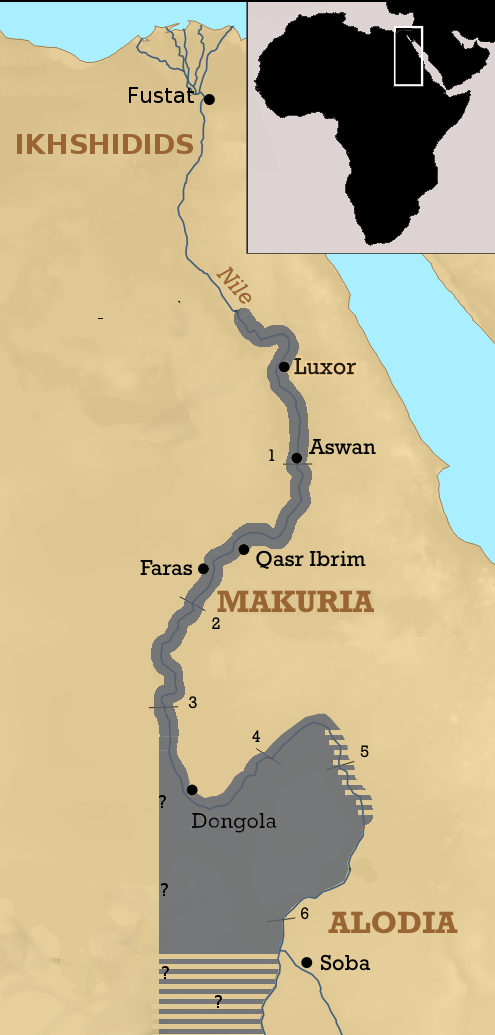
I think the Mizraimite Ludim were the people of the region known in late Antiquity and medieval times as Alodia which name can be traced back to Ancient Kushite inscriptions as Alut.  Here are some maps of late antiquity Christian Nubia.
As an extra Biblical Note, I think Makuria is also the land Herodotus knew as Macrobia.

Since I mentioned Phut, Mizraim's brother, above I might as well deal with the documentation on him.

Pliny the Elder Nat. Hist. 5.1 and Ptolemy Geog. iv.1.3 both place the river Phuth on the west side of Mauretania (modern Morocco). Ptolemy also mentions a city Putea in Libya (iv.3.39).  This might be the same river mentioned by other authors under other names being connected to the Atlas Mountains.

Other references seem to place Phut closer to Egypt.  Putaya was the name of the Persian Satrapy of Libya, Nebuchadnezzar refereed to the Cyrenians as the "Putu Yavan" (Ionians in Libya).  I think this location closer to Egypt is probably where Phut first settled, then they migrated further west and their original settlement was taken over by the Casluhim and Lehubim/Lubim.

The notion that Phut and Lubim became different names for the same place is attested by Josephus in AotJ Book 1:6/2.

Egypt as a major Empire and center of Trade located on the crossroads of two continents had a very diverse population. So none of this means other grandsons of Noah didn't also contribute to ancient Egypt.  I still think the Origins of Osiris and Horus could partly lie in the Horite genealogy of Genesis 36 (thus descent from the Hitties and Hivites), as well as that Seb/Keb/Geb could be partly based on one of the three Sebs who were sons of Cush.

The Philistines.

I feel like ranting on this subject a bit.  We now know that the City of Gaza is indeed the oldest of the Philistine Pentapolis, Biblically it's the only one mentioned in Genesis.  We also know the oldest settlement there was an Egyptian Fort built back in the Early Bronze Age.  We also know it was essentially Egypt's regional capital in Canaan during the 18th and Nineteenth Dynasties.  Meaning archeology tells us exactly why The Bible depicted them as essentially Egyptian Colonists.

But the notion that the Philistines weren't in that region till Rameses III, and that they came from the Aegean, continues to pervade because Egyptian records don't use that name till then.  I think Philistines/Peleset was never what they called themselves but always a mostly derogatory term, related to a Hebrew verb used of wallowing in the dust/dirt.  I think the time of Rameses III is simply when these colonials decided to claim independence from their mother empire like the Yankees in 1776, and so only then did the Pharaoh also use this insulting term for them.

But most importantly the Peleset were NOT Sea Peoples in any 20th Dynasty records, scholars like to group them in with the "peoples of the Sea" and "peoples of the Isles" they allied themselves with, but Rameses III did NOT apply that term to the Peleset or the Tjekker.  

If the Philistines post Rameses III seem in their language and fashion and art similar to the Mycenean Greeks, it's because of cultural exchange via the Denyen/Danoi/Danaans they were allied with, not because they originally came from there.

I also read an English Translation of the Peshita where Genesis 10:13-14 says that out of Casluhim came both the Philistines and Caphtorim.

The Bible says the Philistines main patron Deity was Dagan, this is somewhat a mystery since Dagan is in the standard Canaanite pantheon but not a major player. And Archeologists haven't found the evidence for this, partly because they only count anything as Philistine starting with Rameses III.  We know the Egyptians tended to syncretize storm gods like Baal/Hadad with Set.  So Dagan might have been the Canaanite deity who was identified with Osiris or maybe Amon.

Sunday, June 9, 2024

Capitalism was never Progressive or Revolutionary and Liberalism is not inherently Pro Capitalist.

The problem with the common depiction of the history of the transition from Feudalism to Capitalism in England being focused the Enclosures of the Commons is that the existence of the Commons was actually a problem for either Feudalism or Capitalism, they are both systems that prefer all the land to be monologized by a ruling class.  And indeed most Enclosures that happened during the late Middle Ages and even into the 17th Century were for the Feudal Aristocracy not the proto Bourgeois.

Liberalism in the modern English Speaking world began during the English Revolution with The Levellers led by John Liburne and Richard Overton, just like how Communism was revived with the Diggers led by Gerrard Winstanley.  Overton called for the unenclosing of previously Common Land, the Levellers didn’t want to abolish Private Property entirely like the Diggers, but there being Common Land was a vital part of their vision.

Under Capitalism Private Property is not actually a Right, it’s a Privilege, but people with Privilege love to treat an attack on their privilege as if it violates their rights.  The early Liberals from the Levellers to John Locke to Rousseau saw Property as a Right that all are entitled to.  I am still a Communist who sees ending Private Property entirely as the correct answer.  But I refuse to see these true Liberals as inherently more aligned to Capitalism than Communism simply because of one thing Karl Marx said.

Robert Filmer in Patriarcha created a Private Property ideology much more like what modern Capitalism Apologists believe, and he did so as a Jacobite Royalist supporting Feudalism not as a Liberal, he was a Reactionary not a Revolutionary.  He is who John Locke wrote his discussion of Property to refute as James Tully documents in A Discourse on Property: John Locke and his Adversaries. Also The Inclosure Act of 1773 was passed by the Tory Government of Lord North.

I also recommend reading The Cercle Social, the Girondins, and the French Revolution by Gary Kates.

However, in time some wealthy landowners became influenced by Liberal ideology and slowly started corrupting it with Laisseze-Fair and Meritocratic ideas, principally David Hume in England and the Physiocrats in France.  Real Liberalism is not an ideology that Justifies Capitalism at all, that’s it’s corrupt Prodigal offspring.

The first half of The Communist Manifesto has been described as the most Pro-Capitalist text ever written.  The idea that Capitalism was good when it started, that it “resolved the class contradictions of Feudalism”, that it was necessary for Capitalism to happen before we can do Socialism or Communism is still dogmatically held to by too many modern Marxists especially MLs.

The Liberation that actually happened during this period was accomplished by Liberalism, but even then not everything they were fighting for was achieved.  Then Capitalists Co-Opted Liberalism as they destroyed the only upsides of Feudalism.  Then Marxists start giving Capitalism credit for what Liberalism accomplished while calling Liberalism the Justifying Ideology of Capitalism so they can label any Leftist with actual Democratic Values a “Bourgeois Liberal” while they slowly turn into Fascists with a USSR Fetish.

We also have MLs now rejecting the concept of being Left Wing anymore because of how that terminology originated with the French Revolution and so they say to call yourself Left Wing is merely “the Left Wing of Capitalism”.  The problem is NO the French Revolution didn’t truly create a modern Capitalist state out of France until its Right Wing prevailed on the 18 Brumaire.  The Left during the Revolution included the Enrages and the Conspiracy of the Equals who Marx acknowledged as true Communist precursors, but it also included Anti-Capitalist Liberals like Claude Fouchet and Nicolas Bonneville.

And the problem with Marxism being too Pro-Capitalism was becoming apparent already in the 19th Century when Russia was still under Feudalism.  Early Russian Marxists like Georgi Plekhanov argued that Russia needed to become Capitalist first, and this was vehemently opposed by the Narodniks who went on to form the Socialist Revolutionary Party.  This issue in Russian Marxism led directly to Leninism. 

The belief that we needed Capitalism for the benefits of the Industrial Revolution is ridiculous, I frankly find it incredibly unsettling that so many people who claim to believe in the Collectivist values of Communism think Industrialization required the Profit Motive.

The Youtube channel veritas et caritas has a video on how Co2 emission was known to inevitably be a problem even in the early 1800s.
If Society was never Capitalist the issue could have bene solved way sooner.  Now we're on the verge of it being too late and those in power still refuse to put their short term profit motive aside and do anything about it.  Even though we already found out how to make Electric Cars in the 19th Century.

Saturday, June 8, 2024

The Lords Day is The Sabbath not Sunday

First I want to make clear I'm not a Seventh Day Adventist or a member of any any other dogmatically Sabbath based sect (I am considering being Baptized as a Seventh Day Baptist but they are a denomination not interested in being Judgmental towards those who disagree with them).  

I do not support Legalism, Christians are not bound to observe any weekly service, at all. I'm writing this to refute the notion that The New Testament "Lords Day" is Sunday.

Not everyone who believes weekly Sunday worship is Biblical defines it as Sunday supplanting the Sabbath.  Some like Chris White  just define it as the New Testament ordaining weekly Sunday worship as a separate thing from The Sabbath.  

In The New Testament the term "The Lord's Day" occurs only once. Revelation 1:10 "I was in the Spirit on the Lord's day, and heard behind me a great voice, as of a trumpet".

We're not told what day of the week this is, or if it's a weekly day at all. Sunday supporters just assume this phrase means something distinct from the Sabbath and therefore it backs up their other reasons for saying The New Testament calls for worship on the First Day of The Week.

But in Matthew 12:8 Jesus said He was the Lord of the Sabbath, and Isaiah 58:13-14 calls the Sabbath, "The LORD's Holy Day". So using Scripture to Interpret Scripture this can only mean the Sabbath.

As far as extra Biblical references go (which don't actually matter to me). The Didache (supposedly the oldest Extra-Biblical Christian writing) also does not say when "The Lord's Day" is, just refers to it. The one quote of Ignatius of Antioch often used in this debate says in the only surviving Greek text (which is the language he wrote in) "If, then, those who had walked in ancient practices attained unto newness of hope, no longer observing Sabbath, but living according to the Lord's life ...". Clearly not about when or if we should do a weekly observance at all, simply referring to us not being bound by The Law. Some later Latin texts add "The Lord's Day" to this, and some even make clear it's Sunday, but these are clearly latter corruptions.

It's not till the second half of the Second Century AD. that indisputable references to The Lord's Day being Sunday occur, in texts like the Apocryphal Gospel of Peter, or Acts of Peter, or Acts of Paul, or Acts of John, or Dionysius, Bishop of Corinth in 170 AD. You might think that sounds sufficiently early, but they're after the Bar Kochba revolt which occurred around about a third of the way into the Second Century. That is when the Church started taking on Anti-Semitic tendencies in response to the persecution of Christians carried out under Bar Kochba. I feel this separation of Christian observance from the Sabbath was based solely on that agenda.

Now, for Acts 20:7 and 1 Corinthians 16:2.

The Corinthians reference is to me certainly not about weekly observance. "Upon the first day of the week let every one of you lay by him in store, as God hath prospered him, that there be no gatherings when I come." One could argue that Paul expected his Epistle to be read to the Congregation on a Sabbath meeting, and that they should then begin saving up this money the very next day.

Acts 20:7 I don't really see as calling for anything. It just says they broke bread together, and then Paul preached.

I personally find the debating that goes own between Protestant and Evangelical denominations on when to observe the "Lord's Supper", should it be Weekly, Monthly or Yearly, and so on to be silly. Jesus told us when in the actual account of the Supper itself "when ye eat". It's not supposed to be an appointed ceremony, it's simply a matter of whenever we eat we remember that Jesus's Body was Broken and his Blood was Shed for us.

And I don't think Paul needed a special day to Preach on either, Preaching is simply what he did.

This being during the counting of the Omer means it involved Biblical Significance for the First Day of The Week already in The Torah in Leviticus 23.  The Resurrection and Pentecost were on Sundays because Leviticus 23 ordained them to be, those Sundays being important did not introduce anything new.

I keep hearing that ALL of Jesus post Resurrection appearances were on Sundays from the Evangelical Sunday supporting people.  However only the Doubting Thomas incident could be interpreted that way.  Besides that it's well known The Ascension was a Thursday being day 40 of the Omer (Acts 1:3). 

When you read through Acts, you'll see Sabbath observances are definitely still kept by Early Christians, even Paul. Even if the word Sabbath isn't used, if Paul is disputing with Jews in a Synagogue, you can infer that it is a Sabbath or a New Moon or a Holy Day. And for this reason it's clear that even the Mars' Hill Sermon was preached on a Sabbath not a Sunday, in Acts 17:16-19.

Ezekiel 45 clearly has the Sabbath still being observed in the Messianic Temple.  And I believe that is the New Heaven and New Earth not The Millennium.

So what day we do a weekly observance is not something to be Dogmatic on. Or even if we do a weekly observance at all.  I'm ultimately against the entire modern definition of what a "church" is, archaeology shows no church buildings were built till the Third Century. But the evidence both Biblical and Extra-Biblical shows that the first 2 or 3 generations of The Church met on the Jewish Sabbath, not Sunday.  And then the Nazarenes kept the Sabbath at least into the late Fourth Century.

The history even of the how Sunday replaced Saturday is more complicated then most people realize.  Even in the Nicene Era a lot of Christians were kind of just doing both.

The Eucharist has more Hebrew Bible precedent then just the Passover Seder, it is also connected to Melchizedek's Supper in Genesis 14 and the Shewbread.  The Shewbread was kept in the Holy Place on the Table of Shewbread all Week and then eaten by the Priests on The Sabbath.  Under the New Testament all Believers are the Priesthood, so that is Biblical Support for the Eucharist being part of what we do on the Weekly Sabbath.