Showing posts with label Christmas. Show all posts

Sunday, February 15, 2026

Asherah in The Hebrew Bible

The Canaanite Pagan goddess known by that name really isn't directly mentioned in Scripture, Asherim is a term for a type of Pagan Cultic Object translated "grove" in the KJV that is probably tied to her worship, but as far as being specific about Canaanite Goddess worship the Scriptures are far mor interested in singling out Astarte, The Queen of Heaven.

But there is a lot of talk online about a few archeological inscriptions taken as implying the Israelites worshiped Asherah as the Wife of YHWH.  There is of course plenty of dispute about that reading of these inscriptions, but I have an interesting theory to add.

Etymologically speaking Asherah is a feminine from of a Semitic word that means Happy or Blessed, the same root the name of Asher comes from.  In fact that first time this word appears in Scripture at all is when explaining Asher's name in Genesis 30:13.
"And Leah said, Happy am I, for the daughters will call me blessed: and she called his name Asher."
I looked at every other account of a son of Jacob being named in Genesis 29-30, and only in this one does the mother naming him say something to imply the Feminine from of his name could be an additional name or title for herself.

Another use of this word, when the context implies it's being used in it's feminine form, is Malachi 3:12.
"And all nations shall call you blessed: for ye shall be a delightsome land, saith the LORD of hosts."
The word for "Delightsome" here is the core root that Hephzibah comes from, a poetic name for the Land of Israel in Isaiah 60.

This ties into the theme of Israel being in a sense collectively the Wife of YHWH, Asharah is among her poetic alternate names in that context. 

But there is also some New Testament significance I could add, from Luke 2.

Verse 28 the Angel first appears to Mary and says;
"Hail, thou that art highly favoured, the Lord is with thee: blessed art thou among women."
Then there's the Visitation, 41-48.
"And it came to pass, that, when Elisabeth heard the salutation of Mary, the babe leaped in her womb; and Elisabeth was filled with the Holy Ghost:
And she spake out with a loud voice, and said, Blessed art thou among women, and blessed is the fruit of thy womb. And whence is this to me, that the mother of my Lord should come to me? For, lo, as soon as the voice of thy salutation sounded in mine ears, the babe leaped in my womb for joy. And blessed is she that believed: for there shall be a performance of those things which were told her from the Lord.
And Mary said, My soul doth magnify the Lord, And my spirit hath rejoiced in God my Saviour.  For he hath regarded the low estate of his handmaiden: for, behold, from henceforth all generations shall call me blessed."
If they were originally speaking Hebrew, it's plausible Asharah is the word for Blessed they were using.

This does NOT vindicate Catholic Marian Veneration. It only further shows that Mary being an important woman from the Bible doesn't change that Veneration of Images of her are Idolatry.

Monday, December 1, 2025

Chronological Nativity Narrative

It continues to frustrate me how Secularists insist on seeing the two Nativity Narratives as mutually exclusive incompatible accounts even though they are not even claiming to actually depict the same events. Strictly speaking The Nativity is only in Luke. 

As a Nerd with an interest in franchises like Star Wars, Fate/Stay Night, Raildex, Haruhi and Les Habits Noirs I happen to have experience with trying to explain the most Chronological way to consume a narrative not originally told in Chronological order. And it so happens that skill can be helpful in helping people make sense of The Nativity. 

So here is my Chronological reading order.

Luke 1:5-80.

Matthew 1:18-25.

Luke 2:1-38.

Matthew Chapter 2.

Luke 2:39-52.

I have gone back and forth between different opinions on where in Luke 2 to insert Matthew 2, but I’ve settled on this simplest version for now. 

I can’t claim to know the why of all this besides how Matthew is from Joseph’s POV and Luke Mary’s (well also Zacharias and Elizabeth to a lesser extent for John’s Nativity in chapter 1).  Matthew tells stories that hinge on decisions Joseph makes, while Luke focuses on events only Mary could have the most important perspective on. 

Just as those Fictional sagas I mentioned are told out of order for a reason, I likewise think there is a reason Matthew’s Gospel was the first one written, because it’s the most geared toward a Jewish audience and Paul in Romans 1:16 and 2:9-10 said The Gospel is for The Jews first and then The Gentiles.  The Jewishness of Jesus and his family is also apparent in Luke's Nativity account, but Matthew focuses on fulfilments of Prophecy, while Luke is explaining exactly the things readers who aren't already Jewish wouldn't already know. 

Tuesday, March 25, 2025

The Tabernacle of David

In December of 2023 I made the most refined version of my Zion/The City of David is Bethlehem not Jerusalem argument, more refined mainly in that I resisted the urge to trail off the main topic at hand into more specific geographical speculations.

So I do here want to speculate on where in Bethlehem the Tabernacle of David that for a time housed The Ark of The Covenant was located.  But first I need to talk about some of Bethlehem’s History.

When Emperor Hadrian banned Jews from living in Jerusalem he also banned them from living anywhere Jerusalem was visible from (according to Eusebius Church History Book IV Chapter 6 Section 3).  Jerusalem is visible from Bethlehem. That’s why it’s easy for some more fringe skeptics to try and argue Bethlehem as we know it didn’t even exist before the 130s, there was this massive discontinuity in the population. 

Hadrian also impacted the history of Bethlehem in another way, he built a Temple on the site where the Church of The Nativity now stands.  Fourth Century sources identify it as a Temple to Adonis or Tammuz, it was possibly actually originally part of the Cult of Antinous which was probably from the start Synchronized with those kinds of cults.  I doubt that Church is actually the location of the Nativity (the Cave fixation is Anti-Biblical), but even if it was, Jerome is wrong to claim that’s why Hadrian built a Temple there.  

I doubt Pre-Hadrian Bethlehem ever even had a local Christian population to identify and venerate that location.  The New Testament never refers to missions to Bethlehem focusing instead on the Church’s spread Northwards and Westwards from Jerusalem, nor does Eusebius. There aren’t even any later traditions I can find about there being an Apostle in Bethlehem in the first Century. All Ante-Nicene references to Bethlehem are from a distance, from Justin and Origen.  Christian Bethlehem as we now know it really does begin in the 4th Century.

But even if there had been, the earlier religion whose local legacy Hadrian wanted to blot out was Judaism not Christianity.  In his turning of Jerusalem into Aelia Capitolina the main Temple Complex was built over the former Temple of Herod.  I’m working on another Post about why the Crucifixion and Resurrection of Jesus had to be East of Jerusalem not West or North.

If the original local Jewish population of Bethlehem who Hadrian had just deported remembered that they were the true City of David, then maybe they also remembered where The Tabernacle of David had been?

The Church of The Nativity is most well known to those who’ve never visited it for its underground Caves one of which being where they claim the Manger was (and a Cave was already important to the Adonis mythology). But the Church proper is above those Caves on a Hill with a similar lay out to other Byzantine Churches that can be compared to the design of The Tabernacle and Temple of The Hebrew Bible.

I believe Jesus was born in a house that Joseph owned, so if St Joseph’s Chapel nearby in Bethlehem is the site of St Joseph’s House like it claims to be, then that is where the Nativity happened.

Now I know some people might eventually say “what if the Church of The Nativity is both?  Maybe Jesus was born where The Tabernacle of David was” and that would be neat.  But The Church of The Nativity is too heavily tied to the false Cave tradition.

The Cave tradition is Anti-Biblical but it also can’t be blamed on Constantine or Helena, it is Pre-Nicene, it’s in Justin Martyr, Origen and the Protoevangelium of James.  But none of them Predate Hadrian’s remaking of this entire region.  I think the Cave tradition came from a desire to presume Hadrian was desecrating the place of The Nativity.

I believe Jesus was born in a house that Joseph owned and lived in.  And if the site of David’s Tabernacle was still locally known up until Hadrian it’s unlikely any residential house was there, at best Joseph could have been living in a Davidic Family estate adjacent to it.  So a theory that the Church of The Nativity’s above ground Altar could correlate to where Jesus was born instead of the Cave would be mutually exclusive with that being the Tabernacle of David. 

If I were to consider a second option for the location of David’s Tabernacle, it would begin by asking if the location of the former Kathisma Church would have been considered part of Bethlehem territory rather than Jerusalem in Antiquity?

The Kathisma or “Church of Mary’s Seat” was an Octagonal Byzantine Church on the road from Jerusalem to Bethlehem that tradition said marked a place where Mary rested on the way to Bethlehem.  Christians of Late Antiquity symbolically associated Mary with the Ark of the Covenant, so for example at Abu Gosh which was Kirath-Jearim in The Bible a Church dedicated to The Virgin Mary marks where the locals believe The Ark of The Covenant was kept when it was there.

So a Church of Mary’s Seat built around a Rock that The Ark once rested on is feasible.

Update September 26th 2025: So I've recently learned that my argument for Jesus being born in Josephs' House isn't as Mutually Exclusive with the traditional Nativity cite as I first thought. 

The claim made by the local guides at least is that the Grotto of the Nativity was part of Joseph's House.  It seems it simply was a house into the side of the Mountain and thus partially made up of Caves. 

It's possible much of this wasn't always as Underground as it is now.  There is evidence of Earthquakes in the region possibly during the Bar Kochba Revolt, like the oen Cassius Dio alludes to destroying or damaging Solomon's Tomb. 

Update October 4th 2025: Given how many like to see the contrast between the Tabernacle of David and the Tabernacle of Moses as that's a more open gathering place.  I can't help but feel the part of modern Bethlehem that in spirit embodies The Tabernacle of David is not any specific Church or Mosque but Manger Square. 

Monday, January 6, 2025

Census Before Cyrenius was Governor

So I have become aware of another solution to the Luke 2 Census issue thanks to this PDF.

THE CENSUS AND QUIRINIUS: LUKE 2:2 by Wayne Brinale

This answer is on Page 7 of the PDF saying page 48 at the top. 

I shall now Copy/Paste some form it.
Feldman, in his edition of Josephus, states that "Luke 2:2 can be vindicated only if we translate ... , This census was the first before that under the prefectureship of Quirinius in Syria.'  The adjective prötos may mean "first" or "earlier," "former,".

"First census" must be taken in its Hellenistic connotation as the first of two, and then we must expand the clause a little. "This census was before the census which Quirinius, governor of Syria, made."
I don't understand why so many think the well known Census of the Empire taken in 8 BC can't fit this even when they are not identifying it with AD 6. Is it just an apparent lack of a formal "Decree"?

Again Tertullian says Saturninus was Governor of Syria when Jesus was born without any acknowledgment of how Luke seemingly says someone else was Governor.

And an 8 BC Nativity could have the Passover when Jesus was 12 be the first one after Archelaus died. 

Some people have it in their heads that the Nativity wasn't just before Herod died but very soon before, but I don't know where that comes from.  

In Matthew 2 there is all kinds of ambiguity about how much time separates the Birth of Jesus from the visit of the Magi or the Visit of the Magi form when Herod decided to slaughter the innocents.  But more importantly then those gaps we have no idea how long they were in Egypt, it could have been years. 

Friday, December 13, 2024

When Jesus was 12?

Earlier this year in my post on Age of Consent and Adulthood I argued against using Luke 2:42 as evidence for in any sense considering Adulthood to begin at age Twelve.  And while doing so suggested that maybe the Passover of this story is the first Passover after Herod Archelaus was removed in AD 6.

Again, it's a big IF on even assuming Jesus wasn't brought with for prior Passovers, but if it is the intent to imply this is the first time they brought Jesus with, it's notable to remember that according Matthew 2:22 Archelaus being in power was the reason they didn't want to bring Jesus to Judea. So his removal could have likewise ended that hesitance. 

It seems that some place the removal of Archelaus very early in AD 6 having that year's Passover be the one that happens after his removal.  Remembering that there is no year Zero that counts us backwards to a Nativity in 8 or 7 BC.  But if it was instead the Passover of AD 7 then that puts the Nativity in 7 or 6 BC.  Either way can fit the Census of Luke 2:1-2 being the 8 BC Census when Saturninus was governor of Syria as Tertullian claimed.

I haven't made up my mind on the Chronology of The Incarnation yet, this is just one possibility I'm considering.

Sunday, December 1, 2024

The Adopted Son of Joseph Son of David

Another objection to the Genealogy of Jesus as presented in Matthew and Luke is that Jesus couldn't become an Heir to the Throne of David by Adoption.  Now I still stand by my past arguments for Luke's genealogy actually being Mary's, and even without that nothing anywhere says Mary wasn't a descendant of David.  But considering the value I place on Adoption both morally and theologically, it's about time I said "so what".  Because after all there must be a reason we're given Joseph's genealogy in at least Matthew.

But first, before I even get into that argument. I should address what may sometimes be an internal debate among Christians.  Does Jesus qualify as even an adopted son of Joseph?

Because in the story at the end of Luke 2 when Mary finds Jesus she refers to Joseph as His father, but some people like to say what Jesus goes on to say about doing His Father's business as correcting her.  That has it's origin as an over reaction to how some seek to use what Mary said here against The Virgin Birth.

I feel many American Conservative Christians have dug their heels in on that because of their obsession with the modern nuclear family.  They feel an Adopted or Step father is only needed if the physical sire is a deadbeat or just plain dead, because you can't have "two daddies" that would be horrible.  This is also why so many commentaries refuse to acknowledge that Jacob is referring to Leah as Joseph's mother in Genesis 37.

Luke 4:22 and John 1:45 clearly show that Jesus was legally regarded as a Son of Joseph.

In the past I'd focused more on Luke's Genealogy because even though I've always valued Adoption I felt that Jesus had to be a Blood descendant of everyone Prophecy required Him to descend from so that by His shed Blood gentiles can become Abraham's Seed and mortals can become Sons of God.  And I still think He was, but I've come to realize that Jesus is himself an adopted Son for a reason.

Now when this comes up as a Jewish objection to Jesus, it's not because Jews oppose Adoption or anything, The Torah clearly says anyone Circumcised who follows The Torah is to be considered an Israelite.  It's a claim that Royal Inheritance specifically has to be biological.

II Samuel 7:12 does specifically say Seed.  But it'd be hypocritical to use that against Jesus since these objectors to Jesus often reject dual fulfillment elsewhere.  The immediate context of that verse was clearly the Seed of David who took the throne right after David died.  What's interesting is verse 14 talks about this Son of David being an adopted Son of God.  So the New Testament brings it full circle, The Son of God becomes an adopted Son of David.  And that is why David calls The Messiah his Lord in Psalm 110.

The last verse of Jeremiah 33 seems to say that Israel won't be ruled by the Seed of David anymore when they return from Captivity.  The Root in Isaiah 11 is of Jesse rather then David.  Some Psalms speak of David's Seed, but there is room for interpretation there too.

I stumbled recently unto an online book by a Jew who argues that The Messiah will not be a Son of David but David himself Resurrected, arguing that the Branch is an idiom for a Resurrected Body and looking specifically at Ezekiel 34&37.  As a Christian I obviously disagree with that overall premise, but I do agree that Ezekiel is describing David himself Resurrected as the future Nasi, not using the name David as a code for Jesus as some Christians prefer to look at it.  

I think David himself would take offense at excluding adopted sons from Royal Inheritance, since he was a Son but not by blood of Saul.  In 1 Samuel 24:9-11 David calls Saul "father" and in 1 Samuel 24:16 and 26:17-21-25 Saul calls David his Son.

Now David's Kingship ultimately came from God choosing his line over Saul's.  But likewise the Son of God incarnate doesn't need descent from any specific mortal to be the rightful ruler of The World.  David became a Son of Saul regardless.

Now you may respond that David was the Son in Law of Saul because he married Michal.  To which I first would say, "like how Christian apologists argue Luke's genealogy sometimes means Son in Law when it says Son".  This is also a good time to bring up The Bride of Christ, who is also the Daughter of Zion The City of David.

But another reason David was a Son of Saul was 1 Samuel 18:1-4 where David's Blood Covenant with Johnathon made him Johnathon's joint heir.

What Moses says of Joseph in Deuteronomy 33 is one of the foundations of the Messiah Ben Joseph doctrine that's become popular in Rabbinic Judaism.  It's the basis for saying it's the Son of Joseph not David who will be killed and then Resurrected.  Something I brought up in my Human Sacrifice in The Torah post, which in turn referenced back to my Nazareth post where I suggested that Mary could have been of the Tribe of Manasseh.  For the sacrificial offering alluded to in that blessing it's being a Maternal Firstborn that mattered, the first to Open the Womb.

But the Messiah Ben-Joseph doctrine also needs it to be a Son of Joseph who's pierced in Zechariah 12:10, even though the context of that verse is all about the House of David.  Chapter 12 begins with a new "The Word of YHWH came unto me saying" so no it's not a continuation of the previous three chapters where Joseph and Ephraim came up a lot.  These three chapters seem to be strictly about the Southern Kingdom.  So the only way the one Pierced can be a Son of Joseph, is if he's a Son of Joseph adopted into the House of David.

Sunday, April 14, 2024

Luke does NOT name a Specific Governor of Syria.

 First in the actual Greek text of Luke 2:2 the word translated Cyrenius is the last word and Syria the second to last word.  And the word for "governor" is not a noun and should be more literally translated "governing".  In fact the most accurate rendering of the verse should be something like.
"This counting was first made during the governing of Surias Kureniou"
The last two words I chose not to transliterate and represent them as they are spelled in the Greek.

The only reason why Bible Skeptics insist this MUST be the AD 6 Census in-spite of all the ways it's nothing like that Census (Empire wide not local, and while Herod was still King or at least had been less then 2 years earlier) is the name of Kureniou.

In Josephus Quirinus is spelled Kurinios, which, like I would expect, uses more then one Iota.  Also there is no "e".  It is a much more plausible Greek rendering of Quirinus.

I'm not sure how early on this confusion started.  Maybe simply because Luke refereed to the AD 6 Census in Acts 5:37 people made the wrong assumption it must be the same Census.  Or maybe the translation of Luke into Latin played a key role in the confusion, when Translations of The Bible into modern languages finally began to happen after the reformation, they were greatly influenced by the Vulgate directly or indirectly, even the KJV.

But Tertullian in his against Heresies book IV chapter XIX simply states Saturninus was governor of Syria at the time without any acknowledgment that supposedly Luke identifies someone else as Syria's Governor.  That tells me that neither he or his readers had heard of the idea that Luke tells us who the governor was.  (Note, identifying Saturninus would fit it being the 8 BC Census).  And none of the 3 Lustrums of Augustus would have extended into the 19-21 AD Governorship of Gnaeus Sentius Saturninus, so the claim that Tertulian was referring to younger siblings of Jesus being born then doesn't work.  It was the earlier Saturninus who's administration of Syria coincided with a documented Roman Census.

To be exact, Tertullian said that Roman records proved the fact that censuses (he used the plural) were conducted in Judea when Saturninus was governor.  Also in his Apology to the Jews Tertullian clearly dates the Nativity to 3-2 BC saying it was 27 years from the deaths of Antony and Cleopatra.  But that is hard to reconcile with the Saturninus reference.

Since I'm contending that Kureniou doesn't mean Quirinus, what does it mean?

Below is how Cyrene and Cyrenian (of Cyrene) is rendered in various Greek NT verses.  Because these will be using 2 different Greek letters for o, lower case o is Omicron and capitalized O is Omega.

Matthew 27:32, Kurenaion
Mark 15:21, Kurenaion
Luke 23:26,  Kurenaion
Acts 2:10, Kurenen
Acts 6:9,  KurenaiOn
Acts 11:20, Kurenaioi
Acts 13:1, Kurenaios

It's rendered differently almost each time, in total 5 different ways, and Luke used all 5.  So that Kureniou is identical to none of them means little.  Interestingly the last one is almost identical to how the Strongs incorrectly claimed Cyrenius was rendered (Kurenios) with the only difference being the added Alpha.

The differences are all a matter of vowels and what the closing suffix should be.  All of them begin with Kuren just like Kureniou does.

Ending with iou is the same as how Luke renders Jesus of Nazareth in Luke 24:19 (Iesous tou Nazoraiou).

So perhaps Luke 2:2 wasn't referencing the Governor of a province at all but two provinces?

I could also note that when Luke identifies Pilate as Governor of Judea in Luke 3:1 he lists the name of the Governor before the name of the province.

Maybe the verse should just be translated as saying "when a Syrian was Governing Cyrene"?  Or perhaps that a Cyrenian was governing Syria.  Plausible translations are "during the Governing of Syria and Cyrene" or "during the Governing of Syria by Cyrene" or "during the Governing of Cyrene by Syria".  But I feel from everything I've observed above the best translation is "during the Governing of the Syrian of Cyrene".

An Atheist who is unlike me willing to consider the text hasn't been perfectly preserved should consider that a name is missing, that it's saying someone of Cyrene was Governing Syria.  Heck what Tertullian said you could use as evidence Saturninus was named in the texts he had.

The Roman Legion called the Legio III Cyrenacia was based for some reason in Bosra Syria;  Again I note the terminology of Luke properly translated is not necessarily identifying a person as Governor at all.

The last known exploit of this Legion before the time frame of The Nativity (from the timeline of the Legion Wikipedia has anyway), was being involved in a conflict between Rome and Nubia in Egypt in 23 BC.  The next time they show up is AD 7-11 when the Nikopolis fortress is established.

I'm thinking it's possible this Legion carried out the Census in Judea.

Given how often modern translations claiming to be directly translating the Greek are still influenced by the Latin translation, I was prepared to consider the Latin Vulgate perhaps the origin of this mistake.. But to my surprise the Latin doesn't mention Quirinius here, Jerome or whoever actually wrote the Vulgate did not recognize this as a Greek transliteration of a Latin name, it spells the name Cyrino.
haec descriptio prima facta est praeside Syriae Cyrino
According to Google Translate, everything preceding the two names at the end is, "This was the first President of the".  That is distinct from how the Vulgate does make references to Cyrene, but the main distinction there is using an E where that spelling has an I, something that isn't a difference in the Greek.  So the Vulgate translation is mistaken, but I find it fascinating that the educated Latin speakers who made it didn't see it as clearly a form of a specific Latin name.  This may possibly be similar to the version of the verse Tertullian would have read.

Saturday, April 13, 2024

Herod The Great probably was not of Idumean ancestry

The common claim that Herod was Idumean is built entirely on one passage in Josephus that itself acknowledges that isn't the only view of Herod’s ancestry.  Yet everyone on this issue is inclined to trust Josephus over Nicolaus of Damascus in spite of the fact that Josephus himself had an agenda in writing this History the way he did.

First I’m going to Copy/Paste here exactly the relevant passage from Josephus.
Antiquities of The Jews Book 14 Chapter 1 Section 3.
“ But there was a certain friend of Hyrcanus, an Idumean, called Antipater, who was very rich, and in his nature an active and a seditious man; who was at enmity with Aristobulus, and had differences with him on account of his good-will to Hyrcanus. It is true that Nicolaus of Damascus says, that Antipater was of the stock of the principal Jews who came out of Babylon into Judea; but that assertion of his was to gratify Herod, who was his son, and who, by certain revolutions of fortune, came afterward to be king of the Jews, whose history we shall give you in its proper place hereafter. However, this Antipater was at first called Antipas, and that was his father's name also; of whom they relate this: That king Alexander and his wife made him general of all Idumea, and that he made a league of friendship with those Arabians, and Gazites, and Ascalonites, that were of his own party, and had, by many and large presents, made them his fast friends.”
Here are my issues with what Josephus says about this.

First: It makes no sense to me that Alexander Janneus would appoint someone who was an Idumean to govern a people they’d recently conquered and forcibly converted and intend to fully assimilate in a region he intend to fully annex.  In that situation like when Rome appointed governors of full provinces you appoint someone fully of the ruling nation not the local population.  What was called Idumea during this period was Biblically the heart of Judah's tribal allotment, so I see a lot of logic in letting a descendent of David govern it.

Second: When Rome appointed Client Kings they were always someone with legitimate verifiable Royal Ancestry of the people they are being appointed to rule.  Even Tigranes V of Armenia did descend from Tigranes The Great through his mother.  I know a lot of modern fictionalizations of Ancient Rome want to make it seem like anyone with enough money could just bride the Senate into making them a King, but the Romans understood that in order for a puppet King to be accepted in a culture used to hereditary Monarchy he needed something of a valid ancestry. Herod would have needed to be of Davidic Ancestry especially if he indeed wasn’t a Hasmonean.  Because Rome didn’t crown him King of the Idumeans but King of The Jews.

Third: Look into the history of Costobarus the man who actually led the Idumeans during Herod’s reign, Herod oppressed the Idumeans in a way distinct from the way he can be said to have oppressed the Jews, he clearly viewed them as a Subjugated people not his own people.  Josephus talks about this in Antiquities of The Jews Book 15 Chapter 7 sections 9 and 10. 

Now you may object that “Josephus wasn’t even hostile to all the Herodians, he seems to have liked both Agrippas?".  Those Herods had Hasmonean heritage either way through Mariamne.  Josephus claimed a Hasmonean connection for himself at the start of his autobiography so that kinship may have meant more to him than descent from David anyway.  So Josephus' genealogy makes the Herodians he doesn't like foreigners who shouldn't have ruled Israel and the ones he does like part of a unified dynasty with equal right to rule both Israel and Idumea.

It frustrates me how many Christians take this so for granted they try to read it sub-textually into Herod’s New Testament significance, saying that when The Magi said “Born King of The Jews” it’s partially a dig at Herod’s Idumean heritage.  

The New Testament doesn’t address Herod’s ancestry one way or the other.  But by showing that Jesus’ descent from David could still be documented it does testify against the plausibility of Nicolas of Damascus being able to get away with simply making a Davidic ancestry up. When Josephus wrote Antiquities however much of those records had been destroyed with The Temple in the War, so he could lie about Herod’s ancestry (or uncritically repeat lies others told) without being fact checked.

If the Magi were commenting on an issue with Herod's legal right to rule at all, it could just be him not being the Senior Heir even to his father, he was not Anipater's First-Born.

But mostly I think they are only referring to how Jesus Kingship is more valid because it's ordained by God.  A normal Hereditary Monarch doesn't become King at birth but when their father dies.

I often allude to this view of mine when discussing other things, so I felt it was about time I devoted a specific to defending it. 

Update February 4th 2025: I've now argued that the Idumeans weren't Edomites but only in time accused of being Edomites.  So that could go either way in terms of it's impact on this. 

Update February 12th 2025: I've even become skeptical of the presumable Greek Etymology of the name Herod wondering if it could relate to the designation Harodite from 2 Samuel 23:25.

Update January 19th 2026: I argued all this without knowing about what Julius Africanus said in AD 200 which I found on a Wikipedia Page about the history of how "Palestine" is used. 
 Sextus Julius Africanus, Epistle to Aristides: Some Idumean robbers attacking Ascalon, a city of Palestine, besides other spoils which they took from a temple of Apollo, which was built near the walls, carried off captive one Antipater, son of a certain Herod, a servant of the temple. And as the priest was not able to pay the ransom for his son, Antipater was brought up in the customs of the Idumeans, and afterwards enjoyed the friendship of Hyrcanus, the high priest of Judea. And being sent on an embassy to Pompey on behalf of Hyrcanus, and having restored to him the kingdom which was being wasted by Aristobulus his brother, he was so fortunate as to obtain the title of procurator of Palestine.["Epistle to Aristides" (PDF). Retrieved 2018-06-12.]
I feel very stupid having missed this, but it's not like I regularly read Africanus. 

Too be frank I still this isn't exactly what happened either, it still presumes a degree of Cultural Idemainism in the Herodians I don't believe existed.  But it may be the result of reconciling Josephus's narrative with a different tradition. 

Sunday, December 31, 2023

Stephen implied Moses was born near the Winter Solstice

 Acts 7:20-21
In which time Moses was born, and was exceeding fair, and nourished up in his father's house three months: And when he was cast out, Pharaoh's daughter took him up, and nourished him for her own son.
Which agrees with Exodus 2:2 (and Hebrews 11, this period of time being three months is said three times in Scripture).  Three months separated the Birth of Moses from him being taken in by Pharaoh's Daughter.

But Stephen goes on to evenly divide the rest of Moses life into three periods of 40 years.  40 years in the house of Pharaoh king of Mizraim, 40 years in the house of Jethro, and then the 40 years of the Wilderness Wandering.

The Forty years of the Wilderness Wandering began in Nisan, the Nisan of the First Passover, and ended in a Nisan, the Passover recorded early in the Book of Joshua.  It seems reasonable then to infer all three 40 year periods begin and end in Nisan.

Just looking at the account of Pharaoh's Daughter finding Moses in Exodus 2, there are good circumstantial reasons to suspect this is happening near the Spring Equinox.

So if Moses was born three months before events that happened near the Spring Equinox, then he was born near the Winter Solstice, in December or January.

Likewise, three months means he was taken in by Pharaoh's Daughter at about the anniversary of his Conception. 

Saturday, December 30, 2023

Fast Days becoming Joyful Celebrations

Zechariah Chapter 8 starting in verse 18 is an interesting Prophecy.
And the word of YHWH of hosts came unto me, saying, "Thus saith YHWH of hosts; The fast of the fourth month, and the fast of the fifth, and the fast of the seventh, and the fast of the tenth, shall be to the house of Judah joy and gladness, and cheerful feasts; therefore love the truth and peace. Thus saith YHWH of hosts; It shall yet come to pass, that there shall come people, and the inhabitants of many cities: and the inhabitants of one city shall go to another, saying, Let us go speedily to pray before YHWH, and to seek YHWH of hosts: I will go also.  Yea, many people and strong nations shall come to seek YHWH of hosts in Jerusalem, and to pray before YHWH.  Thus saith YHWH of hosts; In those days it shall come to pass, that ten men shall take hold out of all languages of the nations, even shall take hold of the skirt of him that is a Judean, saying, We will go with you: for we have heard that God is with you."
The Four Fast days alluded to here are the four tied in their origins to the Fall of Jerusalem who's dates are determined by Chronological statements in Jeremiah and Ezekiel.  The fast of the Fourth Month is the 17th of Tammuz, the Fast of the Fifth Month if the 9th of Av, the Fast of the Seventh Month is Yom Gedaliah the 3rd of Tishri and the Fast of the Tenth Month is the 10th of Tevet.

The 10th of Tevet is perhaps the most obscure of these to Gentiles so let me direct you to the Exact Biblical support for The Tenth Month's Fast being the 10th Day of the Month.  2 Kings 25:1, Jeremiah 52:4 and Ezekiel 24:1-2.  

From a New Testament Christian Doctrinal perspective Jerusalem is no longer a single Earthly location but rather the Mishkan is anywhere multiple Believers gather together.

The main point is that the Fast Days are traditionally the Sad days of the Hebrew Calendar.  But YHWH is promising to make them Joyful Celebrations.

Perhaps the last of these listed is the first to be fulfilled?  Perhaps how that day becomes a Joyous Celebration is how The Gospel Narrative Begins? 

A lot of the arguments for Jesus being born around December 25th or January 6th are tied to seeing the Conception of Jesus, the Annunciation and Visitation in the Gospel Narratives, happening around the same time of year as The Crucifixion and Resurrection meaning near the Aviv/Nisan Holy Days.  For example it's believed that must be what Julius Africanus meant when he placed the Incarnation on March 25th, since at the Visitation in Luke 1:41-45 Jesus seems to be already incarnated in Mary's Womb.

Zola Levitt developed a theory about a correlation between the Gestation Cycle and The Torah Holy Days.
I am a little skeptical of parts of it, but the significance of the 14th Day of the First Month seems to hold up.

Gestation is typically 280 days or 9 Month and 10 Days.  So if the First Month of Mary's cycle happened to line up with the first month of the Biblical calendar, the day those days would be completed in Luke 2:6 would be the Tenth Day of The Tenth Month, the 10th of Tevet Fast Day.  And on that day an Angel appeared to the Shepherds in verse 10 to bring tidings of Great Joy.


Right now the Spring Equinox most often falls on March 20th, so if we decide to equate the first of Aviv with the day after, which would be March 21st, that would make the 10th of Tevet December 25th since five 31st days occur in between. 

A January 6th Nativity would then put the start of Aviv on April 2nd, while happening to have December 25th fall during Hanukkah.

Now Ezekiel 33:21 does provide a small justification for alternatively considering the Fifth Day the Fast Day of the Tenth Month, which if that was synchronized to December 25th would make either of the last two days of Hanukkah the Winter Solstice.  And would counting backwards make the Fifth of November the Feast of Jeroboam and Halloween the day the Flood started.

My argument that Biblical Days are Sunrise to Sunrise not Sunset based actually impacts the timing of Christmas.  You see the concept of Christmas Eve came from the Biblical days begin at Sunset assumption, and Luke 2 clearly has Jesus born during the Nighttime Hours.  So it's the night that begins at Sunset December 24th through Sunrise December 25th that is most directly being tied to when Jesus was Born by this tradition.  So if the Fifth of Tevet is synchronized to December 24th then counting backwards Tom Kippur is September 30th making sunset of September 29th the start of the evening of the 9th day of the Seventh Month.  Which would mean Michaelmas could have it's origins in a Christianized Yom Kippur observance.  And it would make March 24th traditional Annunciation Day the first of Aviv, but makes April 7th the Coptic Annunciation day Aviv 14.

But going back to the Tenth of Tevet theory.  If the Day of the Tenth is December 24th then counting backwards that would make Yom Kippur the 25th of September and the first day of Tabernacles the 30th which can also be a theory for the origin of Michaelmas.  And it makes March 20th the first of Aviv.

These Fast Days have their origins in the destruction of the Old Jerusalem and Old Temple of the Old Covenant.  In The New Covenant The Body of Christ is the New Temple and New Jerusalem.

So there ya go, I made a Biblical Argument for celebrating The Birth of The Messiah on December 25th.  One that's flexible even.

Update May 2025: Joy is a key word in all this.  The Christmas song Joy to the World is partly based on Psalm 98.  Chuck Missler used to say singing that Psalm as a Christmas song is Amillennial, and well I have become sorta Amillennial.

Friday, December 29, 2023

Priestley Courses and calculating Christmas

It is still Christmastide so I figured I could make another Christmas post.

The problem with anyone favoring any date thinking they can determine exactly when all the events of the first two chapters of Luke happened by determining when the Course of Abia/Abija served is that all our information on that is spotty.

The Hebrew Bible talks about the 24 Courses of the Priesthood only in 1 Chronicles 24 where it only established that there were 24 and gives each one a name and a number, Abijah being the Eight, it doesn't say for how long each one served or when  And then all Luke chapter 1 itself clarified is that each course has more then one day in verse 23.

It is Josephus in Antiquities 7.14.7 who says they served a week changing over on The Sabbath.  But it's The Talmud Tact Taanith that says Jehoiarib was serving when The Temple was destroyed on the 9th of Av both times.

Even if both those sources are correct there are different interpretations of what implications they have for each other.  Like was there a method to make it so each course consistently serves about the same time of year each year or did it drift meaning Jehoiarib wasn't always serving on the 9th of Av?

And even then there are a lot of assumptions being made by those who think we can calculate Luke's narrative to the day.  Like the fact that pregnancy being 280 days or 9 months and 10 days is not counted by the exact moment of "conception" (which itself isn't really a single moment) but the start of the mother's monthly cycle in which she became pregnant.  And while 280 is the expected standard being born a little early or late isn't unheard of.

However if the Talmudic Tradition mentioned above does go back to accurate memories of who was serving when The Second Temple was destroyed, then it may have also been known to Early Christians who we see even in late chapters of Acts still worshiped in The Temple area and I believe even after 70 AD there was more cultural contact and exchange between Early Christians and Jews then many assume.

Abijah served 7 weeks after Jehoiarib meaning Early Christians would have had good reason to presume the course of Abijah was serving on the 29th of Elul and thus the week of their course with the end of Elul and maybe start of Tishri.  (I'm suddenly tempted to wonder if that has something to do with the 29th of September becoming Michaelmas, but Gabriel would be the Angel to reference for this Biblical Story.)

So based on Luke 1:23-24 they would have felt they had good reason to roughly identify Tishi the Seventh Month of The Biblical Calendar with the first Month of Elizabeth's Pregnancy.  The Annunciation and Visitation happened during the Sixth Month of Elizabeth's Pregnancy in verse 26 which would be roughly Adar.  And thus they would have had good reason to conclude Jesus was conceived in March or early April, and Nine months from that is December or Early January.

Which could reinforce other reasons they might have had to associate Christmas with Hanukkah.  After all Hanukkah is (when there isn't a Second Adar) about 280 days after Purim.

But I do have my skepticism of those Talmudic Traditions, having the first Course listed serving then may have had some symbolic value to them.  Josephus however came form a Priestly family and grew up while the Second Temple was standing so I trust what he says does reflect at least how first century Second Temple Judaism was doing things.

If there was a system to keep them consistent all year, I feel it's safe to assume Jehoiarib the first course would be serving the first week of Nisan/Aviv.  It would take 168 days for all 24 Courses to have each served once meaning Jehoiaiab would start serving again on the 19th day of the sixth month which would be Elul.  But some have theorized the Pilgrimage Festivals (at least the week long ones) would be separate from the Course system since all the Priests would have been present, that would start the second course of Jehoiarib on the 26th or 17th of Elul.

That would put Abijah's first course of the year on the 50th-56th days of the year or 20th-26th of Iyar, unless the Unleavened Bread Pilgrimage festival interrupts things then it's the 57th of Iyar through the 3rd of Sivan.  Five months later that could oddly work for placing the Annunciation near Halloween and the Nativity in August.

However the second Course of Abijah would then be the 9th through 16th of the Eight Month, possibly making the Eight Month Elizabeth's First Month and thus her sixth month either Nisan/Aviv or Second Adar which comes right back around to supporting a Hanukkah or 10th of Tevet Nativity, because Aviv as Mary's First Month perfectly fits Zola Levitt's theory about the Torah Holy Days and the Gestation Cycle.

But as I said before we can't know for certain.  The information we have here can and has been tortured to make any model work.  But two of the quickest conclusions one can come to lend themselves to justifying a near the Winter Solstice Nativity.

Monday, December 25, 2023

Venus as The Star of Bethlehem

I am strongly convinced that the terminology of "We have seen (Observed) His Star" implies a Star that was always there and always considered His.  And that logically as one that moves around it would be a planet.

When The Bible associates Jesus with a star, it associates Him with the Morning Stat in 2 Peter 1:19 and Revelation 22:16.  Which is Venus called Heosphorus/Eophorus(Dawn Bringer), Hesperus and Phosphorus (Light Bringer) by the Greeks and Lucifer by the Romans.

The use of the name "Lucifer" in Isaiah 14:12 is not justified by the Hebrew Text, Isaiah is not in my view describing an astronomical object at all.  The flawed Septuagint began the association of this verse with Venus but even it used Heosphorus not Phosphorus.  I have come to favor the Peshita reading of Isaiah 14:12 as the accurate representation of what Isaiah meant where what we're used to reading as "Lucifer son of the Morning" is instead "Howl at The Morning".

Lucifer is the direct Latin equivalent to the Greek word used in 2 Peter 1:19.  During the 4th Century there were Christians named Lucifer, no one thought of it as a reference to Satan yet.  This is why Latin Hymns will call Jesus Lucifer and then English Speaking KJV Only Protestants point to them as proof that the Vatican secretly worships Satan.

I believe Jesus rose from the Dead at Sunrise on Sunday Morning.   The day I have argued in the past that happened, April 9th 30 AD, was a day that Venus was visible in Israel in the morning as a Morning Star.

And my current 12 BC Nativity model has Venus visible in Israel as an Evening Star through when Hanukkah probably happened in December of 12 BC.

Also every year Venus is at it's brightest in Late November and early December, so about a month before Christmastide.

Tuesday, December 19, 2023

Christmas and Hanukkah

The idea that Christmas is Pagan in origin is thoroughly debunked by people much better at that then I am, including YouTubers like ReligionForBreakfast and InspiringPhilosophy.  

The Pagan Holidays that were observed around the Winter Solstice in the BC Era were not Birthdays but if anything usually that pagan god's equivalent to Easter being when The Sun kinda dies and rises again.  Osiris and Horus had birthdays in September and Apollo's was in May.

And none including Sol Invictus were tied to December 25th specifically till 354 AD by which time Christmas being observed then was firmly established.  The Donatists also observing it on December 25th proves that association has Pre-Nicene Origins.

I'm not invested in trying to prove this time of year is in fact accurate.  I consider some of the arguments against it silly and weak, but The Bible didn't tell us exactly when Jesus was born (at least not directly) therefore it's not something we need to know.

What I do believe is that way more early Christian practices had their origins in evolving from continued Jewish practices filtered through certain New Testament concepts then most people realize.  I'll try to talk more about that in future posts next year.  For now though I do think there is logic to seeing Christmas and Hanukkah happening around the same time of year as not mere coincidence.

Jesus observed Hanukkah in John 10:22 so logic dictates early Christians who included that book in their Canon would have done the same.  I suspect the mysterious origins of Michaelmas similarly have their roots in Christian observances of one of the Tishri Holidays possibly via John 7.

Hanukkah is the only prior precedent for any Late Fall/Early Winter religious observance being on the 25th day of the month.  And if when translating customs from a Jewish Calendar to a Roman Calendar you decide to equate Nisan/Aviv with April the first full month of Spring and the month in which the Romans observed their own Barley Harvest festival the Cerealia.  That makes December the Ninth Month.

Maybe Christians celebrating Hanukkah in a Christian way didn't originally identify it with Jesus's Birthday but decided that should be the basis for the Holiday once it's Jewish Roots were partly forgotten?  And/Or maybe they felt there were good thematic/symbolic reasons to associate the Nativity Narratives with Hanukkah?

Hanukkah means Dedication referring to the rededication of The Temple after the Hasmonean Revolt succeeded.  In John 2:19-21 Jesus refers to His Body as "This Temple", so the Nativity events recorded in Luke 2 and Matthew 2 could be viewed as the Dedication of that Temple.  Herod could even be viewed as a new Antiochus Epiphanes in that context.

Christians would have also noticed that if Jesus was born on the first day of Hanukkah then his Circumcision would have been on the last day since it's an Eight Day Festival bringing us down to verse 21 of Luke 2.

Now we know from cross checking with Leviticus 12 that what Luke 2:22-39 records wouldn't have happened till 33 days later.  But since Luke doesn't directly state that timeframe the way he does the Circumcision timeframe, some early Christians could have felt justified in associating all of this with still being the Eight Day at least thematically.  Maybe someone at some point might have gotten what law Luke was referencing wrong and looked at Leviticus 15:29 instead?  It is notable that Candles became associated with the Mass commemorating this passage, which of course is no February 2nrd Candlemas.

Hanukkah is called The Festival of Lights and Jesus is called The Light of The World at many points in The Fourth Gospel (1:4-9, 3:19-21, 5:35-36, 8:12, 9:5, 11:9-10, 12:35-46) and the Epistle known as 1 John (1:5-7 and 2:8-10), and the Light-Bringer (Day Star in the KJV) in 2 Peter 1:19, and it's even in Simeon's Prophecy in Luke 2:32.  It's called the Festival of Lights because it's tied to The Menorah(Candlestick) which is mentioned or alluded to in The New Testament in Matthew 5:15, Mark 4:21, Luke 8:16, 11:33, Hebrews 9:2 and Revelation chapters 1, 2 and 11 where the last reference connects to Zechariah 4 which is itself often associated with Hanukkah along with Haggai 2:10-23 which becomes Christmas Eve in this model. 

In Leviticus 24 Frankincense (and possibly indirectly Myrrh) are linked to the Menorah and the Shewbread.  Leviticus 23 was all about Holy Days and then chapter 25 returns to Calendar related concerns, so Leviticus 24 naturally could have become thematically linked to Hanukkah.  And of course the Menorah and the Table of Shewbread were made of Gold.  

It's also important to remember that a lot of the specifics of how we think of Hanukkah today are post Diaspora developments (just as a lot of the finer details of the modern Passover Seder are), even the Miracle of the Oil story doesn't show up till the Talmud.  It seems like Second Temple Judaism's Hanukkah was largely just a sort of second Tabernacles, principally it was a time for feasting.  There were no Dreidels yet or giving a gift on each day, and maybe not even yet the custom of lighting one additional candle every day.

Same is true with Christmas of course, most of how we think about it today even as a religious Holy Day wasn't always there.  It's main function originally was as a Feast Day.

Looking at the history and details of Christmastide aka The Twelve Days of Christmas I notice that Epiphany is the only day after the Circumcision that has any special observance to it, the 2nd, 3rd and 4th days of January just have readings that don't even feel very Christmas related.  The oldest reference to Epiphany we have is post Nicaea in AD 361 by Ammianus Marcelinus and it doesn't clarify the exact day just saying it's at the start of January, almsot like it was another name for the Feast of the Circumcision.  Epiphany also gets associated with Jesus's Baptism in some early references, and I feel it's worth noting here that Gentile Christianity by this time was already developing the false doctrine that Baptism replaced Circumcision to justify their false practice of Infant Baptism.

Epiphanius of Salamis said that Epiphany is the same day as the Nativity, but he represents the more obscure to the west tradition of making Christmas January 6th.

Maybe Christmastide was expanded from 8 days to 12 specifically to obscure the Hanukkah connection during this Romanizing era?

Wednesday, December 13, 2023

Shepherds In Winter

The only real Biblical argument against a winter birth for Jesus is a claim that Shepherds would not have had their flocks outdoors in winter.  These people are forgetting that Israel does not have the climate of Northern Europe or America.
Genesis 31:38-40: "This twenty years have I been with thee; thy ewes and thy she goats have not cast their young, and the rams of thy flock have I not eaten.  That which was torn of beasts I brought not unto thee; I bare the loss of it; of my hand didst thou require it, whether stolen by day, or stolen by night.  That which was torn of beasts I brought not unto thee; I bare the loss of it; of my hand didst thou require it, whether stolen by day, or stolen by night. Thus I was; in the day the drought consumed me, and the frost by night; and my sleep departed from mine eyes. "
Jacob was at this time much further north then Bethlehem, yet he was engaged in Shepherding during the winter.  So using the no shepherds in winter argument calls Scripture a liar. 

James Kelso, an archaeologist who spent a number of years living in Palestine and who has done extensive research there says this:
The best season for the shepherds of Bethlehem is the winter when heavy rains bring up a luscious crop of new grass. After the rains the once-barren, brown desert earth is suddenly a field of brilliant green. One year when excavating at New Testament Jericho, I lived in Jerusalem and drove through this area twice every day. At one single point along the road, I could see at times as many as five shepherds with their flocks on one hillside. One shepherd stayed with his flock at the same point for three weeks, so lush was the grass. But as soon as the rains stopped in the spring, the land quickly took on its normal desert look once again.
Since there seem to have been a number of shepherds who came to see the Christ child, December or January would be the most likely months (James Kelso, An Archaeologist Looks At The Gospels, p. 23-24).
 Also there is Canon H.B Tristram
“A little knoll of olive trees surrounding a group of ruins marks the traditional site of the angels’ appearance to the shepherds, Migdol Eder, ‘the tower of the flock’. But the place where the first ‘Gloria in excelsis’ was sung was probably further east, where the bare hills of the wilderness begin, and a large tract is claimed by the Bethlehemites as a common pasturage. Here the sheep would be too far off to be led into the town at night; and exposed to the attacks of wild beasts from the eastern ravines, where the wolf and the jackal still prowl, and where of old the yet more formidable lion and bear had their covert, they needed the shepherds’ watchful care during the winter and spring months, when alone pasturage is to be found on these bleak uplands“. Picturesque Palestine Vol 1 page 124
 Also note this excerpt from Messianic Jewish Scholar Alfred Edersheim:
“That the Messiah was born in Bethlehem was a settled conviction. Equally so, was the belief that He was to be revealed from Migdal Eder , the tower of the flock.
This Migdal Eder, was not the watch tower for ordinary flocks which pastured on the barren sheep ground beyond Bethlehem, but lay close to town, on the road to Jerusalem. A passage in the Mishnah leads to the conclusion that the flocks which pastured there were destined for Temple Sacrifices, and accordingly that the Shepherds who watched over them were, no ordinary Shepherds. The latter were under the ban of Rabbinism on the account of their necessary isolation from religious ordinances, and their manner of life, which rendered strict legal observances unlikely, if not absolutely impossible.
The same Mishnic also leads us to infer, that these flocks lay out all year round , since they are spoken of as in the fields thirty days before Passover- that is, in the month of February, when in Palestine the average rainfall is nearly greatest. Thus Jewish traditions in some dim manner apprehended the first revelation of the Messiah from Migdal Eder, where Shepherds watched the Temple flocks all year round. Of the deep symbolic significance of such a coincidence, it is needless to speak -The Life and Times of Jesus the Messiah By Alfred Edersheim
I've also seen it claimed by some that Israel is "impassable" during winter, and Mary and Joseph couldn't have traveled south at this time.  But John 10:21-22 tells us Jesus traveled to Jerusalem to keep the feast of the Dedication/Hannukah.  Indeed I take from this passage that Hanukkah while not one of the required pilgrimage days became an unofficial additional one, since it was intimately about Jerusalem and The Temple.

But also as shown in my Magi and the Census post, I think it's a wrong assumption that they traveled to Bethlehem just before Mary gave birth, I think they had been there for months already.

Nativity in 12 BC

I’ve been slightly off in the past when I mention saying that a Romans census took about 5 years.  I just went by the usual known Census dates and assumed they dated the start of that 5 year period, allowing the 8 BC Census to end in 4 or 3 BC.

In actuality the Monumentum Ancyranum inscription states that Augustus completed a Lustrum in 8 BC, the year Censorinus and Asinius were Consuls.  That would make the first year of that Lustrum 12 BC.  Some translations word this more vaguely, but I think the version identifying 8 BC as when it was completed may be correct.

Now I’ve made a big deal before about deconstructing the assumption that Luke mentions Quirinus, however it's interesting that 12 BC was the year Quirinus was Consul.  Again Luke 2 doesn’t use a word for Governor, but for governing.  The Legate of Syria at this time was Marcus Titius, but he was brand new in the office, it’s not difficult at all to imagine one of the Consuls was overseeing the East.  Especially since 12 BC was also the year Quirinus started his campaign against the Homonadenses.  He wasn't actively serving as Consul anymore by the year's end, but he was still one of the Consuls the year was named after. 

When exactly Marcus Titius was made governor is disputed exactly, 12 BC may have started with Marcus Agrippa still the Governor, but he was an absentee Governor who rarely actually resided in Syria.

Of course given the common interpretation of Luke 2:1-2 saying the Census began during the governing of Quirinus, and the Roman custom of naming years after the Consuls at it's start.  It could be this Lustrum was gonna be identified with Quirinus regardless of when during it Jesus was born.

Some before have argued for a 12 BC Birthdate for Jesus.  They get a lot of stuff wrong (including the common anti December 25th memes), starting with wanting to see Halley's Comet as the Star of Bethlehem.  Since I place the Star of Bethlehem a little under 2 years before Jesus was born, not at his birth, my model here would use the Star of Bethlehem candidate(s) usually favored by 15 or 14 BC theorists, when there were more Jupiter-Regulus conjunctions, and some interesting movements with Venus.  And that when Hanukkah would have happened in December of 12 BC, Venus was visible in Israel as an Evening Star according to Stellarium.  

But the previous year's Hanukkah had Venus visible as a Morning Star.  That year the 25th of Kislev would have began probably at sunset of December 23rd.  And then perhaps the magi arrived in Jerusalem when Jesus was born around Sunrise of December 24th, and arrived at Mary and Joseph's house exactly 24 hours later.  That model would put the beginning of Nisan of 13 BC around the 6th of 7th of April.

There could be more time between the family going to Egypt and Herod’s death then people usually assume.  The word for “young child” used at the time they return from Egypt, can simply mean not fully an adult yet, Mark 5:40-42 uses it of a 12 year old.

Now that goes against some of what I’ve argued before.  I do still believe the Magi arrived in Jerusalem when Jesus was born.  But it might be Herod didn’t give up on waiting for the Magi to return till after the 40 days.  Maybe he wasn’t in Jerusalem when Simeon and Anna gave their prophecies.  He was often not in Jerusalem, he may have been there for when the Magi arrived only because he was there to celebrate Hannukah.

Some think Simeon the Just of Luke 2 was probably a Priest and maybe even the High Priest.  That this date puts the nativity during the administration of Simon Beothus is pretty interesting then.   One of the more overlooked things Josephus said about the house of Simon Beothus is that they descended from Onais IV.

I believe Simeon the second Bishop of Jerusalem was the same person as Simon the half brother of Jesus (in-spite of the early Catholics wanting to call him a son of Clopas).  I believe all of his half siblings were younger, since I believe Mary was their mother and Jesus was obviously her first born.  Simeon’s death is dated to 117 AD, and he was apparently 120 years old when he died, according to Eusebius (http://www.ccel.org/ccel/schaff/npnf201.iii.viii.xxxii.html).  That would place the birth of Simon in 5 or 4 BC.  Assuming they were named in the order they were born, James and Joses were also older than Simon.  So that is potential evidence against my past desire to place Jesus's Birth right before Herod died.

However that date for Simeon’s death may be too late.  Since it’s also said to be while Tiberius Claudius Atticus Herodes was Governor of Judea, which was from 99-102.  However the chronology of post Josephus governors of Judea isn't established as firmly.  The scenario presented makes most sense as being in the context of the Kitos War.

Update March 2024: So apparently most translations of  the Monumentum Ancyranum inscription do not support I asserted above.  So that weakens the thesis a bit.

Herod's Death and the lunar Eclipse

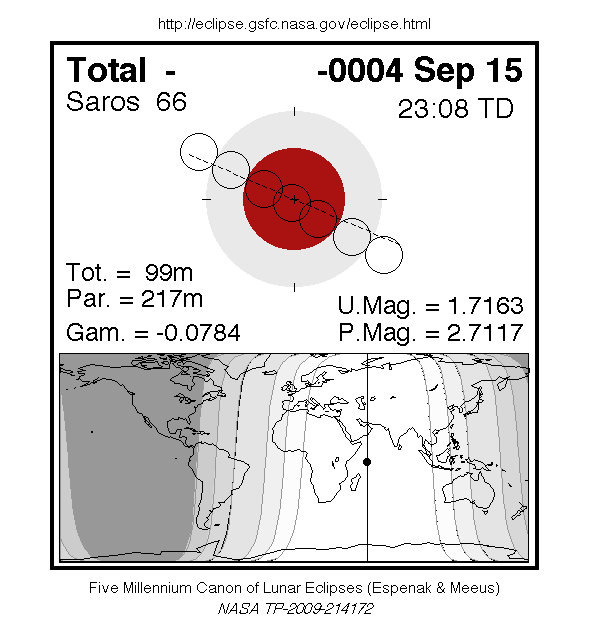
 I had in the past long favored the January 1 BC Eclipse being the one that precedes the Death of Herod.  But I eventually came to feel the mainstream view of it being the March 4 BC Eclipse is correct.

Taken from.
https://www.biblicalarchaeology.org/daily/people-cultures-in-the-bible/jesus-historical-jesus/herods-death-jesus-birth-and-a-lunar-eclipse/
There are three principal reasons why the 4 B.C. date has prevailed over 1 B.C. These reasons were articulated by Emil SchĂ¼rer in A History of the Jewish People in the Time of Jesus Christ, also published in the 19th century. First, Josephus informs us that Herod died shortly before a Passover (Antiquities 17.9.3, The Jewish War 2.1.3), making a lunar eclipse in March (the time of the 4 B.C. eclipse) much more likely than one in December.
Second, Josephus writes that Herod reigned for 37 years from the time of his appointment in 40 B.C. and 34 years from his conquest of Jerusalem in 37 B.C. (Antiquities 17.8.1, War1.33.8). Using so-called inclusive counting, this, too, places Herod’s death in 4 B.C.
Third, we know that the reign over Samaria and Judea of Herod’s son and successor Archelaus began in 4 B.C., based on the fact that he was deposed by Caesar in A.U.C. (Anno Urbis Conditae [in the year the city was founded]) 759, or A.D. 6, in the tenth year of his reign (Dio Cassius, Roman History 55.27.6; Josephus, Antiquities 17.13.2). Counting backward his reign began in 4 B.C. In addition, from Herod the Great’s son and successor Herod Antipas, who ruled over Galilee until 39 B.C., who ordered the execution of John the Baptist (Mark 6:14–29) and who had a supporting role in Jesus’ trial (Luke 23:7–12), we have coins that make reference to the 43rd year of his rule, placing its beginning in 4 B.C. at the latest (see Morten Hørning Jensen, “Antipas—The Herod Jesus Knew,” BAR, September/October 2012).
Thus, SchĂ¼rer concluded that “Herod died at Jericho in B.C. 4, unwept by those of his own house, and hated by all the people.”
Jeroen H.C. Tempelman
New York, New York
While I know you can play games on how to reckon what Josephus said of the length of Herod's reign.  The argument that the reigns of Antipas and Archelus must have included Co-Regencies simply doesn't work.  The death of Antipater is synchronized to the Death of Herod, Herod died 5 days later.  So you can't move Herod's death to a later year but keep Antipater's in 4 BC as I've seen some but not all 1 BC arguments do.  It was after Antipater died that Herod changed his will to the arrangement that wound up happening.

The reference connecting the Eclipse to a Fast has been used by 1 BC and September 5 BC advocates to support making it Yom Kippur.  This connects to a desire to see any unspecified Fast as Yom Kippur even though that day isn't stickily a Fast day though it's popular to Fast on it, and is not even the main fast day of it's own month. (that would be Yom Gedlaiah, the third of Tishri).

Here is the thing I've noticed that even most arguing for the March 4 BC Eclipse overlook.  What Josephus says is that the Eclipse of the Moon happened the night the Fast day ended, no gap.

First in case you didn't know, Jewish days begin and end at Sunset, or at least it's presumed they already were in the time of Herod.

Second the Biblical New Moon/Rosh Codesh is the first visible crescent, not the day the Moon is invisible.  So Full Moons (the only day a Lunar Eclipse can happen) are the 14th day of each Hebrew Month, not the 15th as the Blood Moon theorists claimed.

In other words, this Fast must have been the Thirteenth day of it's Hebrew Month. So that doesn't fit Yom Kippur which is the 10th, or any of the 4 major Fast days linked to the first Fall of Jerusalem which are the 9th, 17th, 3rd and 10th days of their months.

The only Jewish Fast day we know of that was being kept at that time that would have been the 13th day of the Month, was the Fast of Esther, which is the 13th of Adar, the day before Purim.  Meaning this Full Moon was Purim, meaning of the 4 lunar eclipses considered likely, only March 4 BC fits.

Now I should mention that since I and others have seen "Blood Moons" on Full Moons that neither Stelarium or other Astronomers recognize as such (like in August of 2015).  I'm not confident the Eclipse Josephus mentioned can be identified by any modern means at all.  But either way it must be a 14th day of a Month and of known Fasts only Adar has one on the 13th.

Now the argument still remains that one month between the Eclipse and Passover doesn't quite seem enough for everything Josephus says happened.  It could be there was a Second Adar (Modern Rabbinic Judaism observes Purim in 2nd Adar but the Biblical reckoning favored by Kariates which may have still been the one used at this time clearly defines it as in the 12th Month which second Adar wouldn't be).  Or maybe all these events caused Passover to be pushed back to Second Passover.  Or maybe Josephus who sometimes was less chronological then you'd expect wasn't putting as much in that time-frame as we think.

Some have calculated 20 or 21 days from the Death of Herod till Passover.  Which could put the Death of Herod on the 25th of Adar, same day traditionally viewed as the Death of Nebuchadnezzar (Jeremiah 52:31).

The main reason why many Christians regardless of what day of the year they favor feel the need to push Herod's death later is assumptions that I feel are mistaken about what we're told in Luke 3.

 Another factor is a desire to affiliate the Census of Luke 2 with a 3 or 2 BC Oath of Obedience to Augustus, which I'd supported myself in the past.  But I now just focus on that the main Imperial Censusus Augustus ordered.

Returning to the Eclipse in question.  The argument for the Fast being Yom Kippur is the emphasis on the High Priest having duties that day.  As the Jewish Encyclopedia says.  While Yom Kippur is the busiest day of the year for the High Priest, it's not the only day he has responsibilities.  At any-rate if Josephus was exaggerating when he made it sound like the Eclipse was the very next day, which is what you'd have to argue for it to be Yom Kippur, then the statement mostly becomes chronologically useless.  If it was Yom Kippur then it still must have been the next full moon which makes only the September 15 5 BC fit in which case the next Passover is still the same Passover.

Monday, December 4, 2023

Zion, The City of David wasn't Jerusalem

In 2 Samuel 5:7 and 1 Chronicles 11:5, the word "Nevertheless" in the KJV is not based on a word in the Hebrew text.

Young's Literal Translation of 2 Samuel 5:6-10.
 6 And the king goeth, and his men, to Jerusalem, unto the Jebusite, the inhabitant of the land, and they speak to David, saying, `Thou dost not come in hither, except thou turn aside the blind and the lame;' saying, `David doth not come in hither.'

7 And David captureth the fortress of Zion, it [is] the city of David.

8 And David saith on that day, `Any one smiting the Jebusite, (let him go up by the watercourse), and the lame and the blind -- the hated of David's soul,' -- because the blind and lame say, `He doth not come into the house.'

9 And David dwelleth in the fortress, and calleth it -- City of David, and David buildeth round about, from Millo and inward,

10 and David goeth, going on and becoming great, and Jehovah, God of Hosts, [is] with him.
From Benton's Septuagint Translation of 2 Samuel 5:6-10.
6And David and his men, departed to Jerusalem, to the Jebusite that inhabited the land: and it was said to David, Thou shalt not come in hither: for the blind and the lame withstood him, saying, David shall not come in hither. 7And David took first the hold of Sion: this is the city of David. 8And David said on that day, Every one that smites the Jebusite, let him attack with the dagger both the lame and the blind, and those that hate the soul of David. Therefore they say, The lame and the blind shall not enter into the house of the Lord. 9And David dwelt in the hold, and it was called the city of David, and he built the city itself round about from the citadel, and he built his own house. 10And David advanced and became great, and the Lord Almighty was with him.
An argument can be made that the account of how Jerusalem came under David's control (2 Samuel 5:6-9 and 1 Chronicles 11:4-8) makes more sense if Jebus and "Zion which is the City of David" are separate cities.  And this fits later references to the two locations in the time of Solomon also, The Ark was brought out of the City of David to The Temple, and likewise the Daughter of Pharaoh was brought out of the City of David to Solomon's house.  It looks like after the Jebusites chose to resist, David simply chose the fortress of Zion to be the base of his campaign against Jebus.

It might be that Jerusalem is sometimes used broadly of an entire district, but when used specifically of a single City it's just Jebus.  

Some references to Jerusalem and Zion in the same verse often taken to verify their being synonymous, can also work as listing separate cities side by side.  Like Isaiah 64:10 which says cities, plural, then lists Jerusalem and Zion.  But since Zion also arguably has both a poetic broader application and a more specific one, perhaps it fits when paired with Jerusalem, two names that refer to different specific cities but basically the same area when applied broadly.  Psalm 76:2 also makes sense as referring to Salem and Zion as separate cities.

It's possible sometimes Jerusalem and Zion are paired together to represent the two tribes of the Southern Kingdom, Benjamin and Judah, Psalm 78:68 says Zion is a mount of Judah, and we all know Jerusalem was in Benjamin.  Which can in turn be taken back more broadly to represent both wives of Jacob, Benjamin from Rachel and Judah from Leah.

And perhaps David's plan for this area was similar in intent to the original plan for Washington DC, taking parts of both Maryland and Virginia to create a capital District.  Isaiah 24:23 refers to YHWH ruling in Zion and in Jerusalem, as if they are separate.

One question that might pop into your mind from the idea of separating Jerusalem from the City of David is, which city then is Ariel in Isaiah 29?  "Where David dwelt" could apply to both but arguably fits the City of David better, and Zion is mentioned explicitly.  Also Ariel means "Lion of God", that fits it being a Judean rather then Benjamite city, as Judah is the Lion in Genesis 49.  Other tribes (Gad and Dan) are associated with Lions elsewhere (Deuteronomy 33), but not Benjamin.

I think the house David built with materials provided by Hiram of Tyre was in Jebus/Jerusalem, where he lived and had children with his wives from Jerusalem, and that could be the same archeological site it's usually associated with.   But the Fort of Zion was in the City of David.

Ophel is a word some use as a geographical indicator, it however is a term for a place many cities had.  Samaria also had an Ophel mentioned in 2 Kings 5:24, which the KJV translated "tower". 2 Chronicles 33:14 says the City of David had an Ophel while reminding us the City of David was in Judah.  And 2 Chronicles 27:3 connects one to the House of YHWH. Isaiah 32:14 uses Ophel in a plural form becoming "forts" in the KJV.

Only 2 Chronicles 1:4 says David pitched a Tent for the Ark in Jerusalem rather then Zion or the City of David.  First off the books of Chronicles probably entered their final form later, so a broader definition of what qualifies as Jerusalem may make more sense there.  But also it may just be skipping a step in what actually happened here.  II Samuel 15:24-29 is when The Ark first comes to Jerusalem.

I don't believe the Spring we today call the Gihon is the Biblical Gihon, but also the Gihon is never described as within The City of David. The City of David isn't mentioned 1 Kings 1.  The two verses where The City of David and the Gihon are mentioned near each other are 2 Chronicles 32:30 and 33:14, both clearly imply the Gihon as a separate location from the City of David proper. 

If you believe the Gihon of Genesis 2 is the same as the Gihon referred to in Israel later then that's a River not a Spring.  But that would conflict with assuming the Euphrates and Tigris it refers to are the ones in Mesopotamia, but I do have my own reason for doubting that assumption to. So some good rivers near Jerusalem to identify with the Gihon are what we today call the Nahal Sorek (the name Sorek in The Bible is a valley connected to that ancient River) or the Nahal Nar/Kidron Stream.

I think Jerusalem may often be what's called the Daughter of Zion or Daughter of Sion. But "daughter of ____" can sometimes refer to a separate City that is related in some way.  Like Tyre being the Daughter of Sidon/Zidon in Isaiah 23:12.  And the Daughter of Babylon I think is likely Hammurabi/Nebuchadnezzar's Babylon, the daughter of the original Babel.  Likewise the "Daughter of Jerusalem" may refer to the post Captivity Jerusalem more so then the original Jebus.  But not always, sometimes the "Daughter of _____" just refers to the population of the city, which is why it can also refer to some of that place's population dwelling somewhere else, descendants of David living in Jerusalem made it a daughter of Zion.

Or the Daughter of Jerusalem and Daughter of Zion can be the same daughter since ya know most daughters have two parents.  1 Chronicles 9:3 says that the population of Jerusalem included people of Judah, Benjamin, Ephraim and Manasseh, so that's descendants of Judah and Rachel. 

But I also sometimes think from a New Testament perspective that New Jerusalem is the Daughter of Jerusalem who is in turn the Daughter of Zion.

The phrase "City of David" appears four times in 1 Maccabees (1:33 2:32 7:32 and 14:36) at least two of them seem to identify the City of David as part of Jerusalem.  But our surviving copies of both books of Maccabees are preserved mainly through Christian manuscripts that are 4th century at the oldest.   Josephus when covering the same time period using I believer a version of 1 Maccabees closer to the original doesn't use the phrase "City of David" at all.

What about all those statements from the Prophets and Psalms that seem to place The Temple on Zion?

Well the Prophets are being Prophetic and the Psalms are either also Prophetic and/or Davidic ones that are about David's Tabernacle which was in the City of David.  Psalm 132 seems to tell us the place of David's Tabernacle was where he meant for The Temple to be built.  Stephen in Acts 7:45-49 seems to be implying Solomon's Temple did not follow David's intent.  Many Prophetic references are explicitly about restoring the Tabernacle of David not Solomon's Temple, like Isaiah 16:5, Amos 9:11 and Acts 15:16.  My post  on Ezekiel's Temple talked about how the eschatological Temple may really be a Tabernacle.

The New Testament only seems to use Sion and Jerusalem synonymously in Hebrews 12:22 where Paul is commonly viewed as speaking of a Heavenly Jerusalem not a terrestrial location.  But even there they could make sense as different terrestrial locations that are linked Spiritually, by both having housed The Ark just as The Church now houses The Holy Spirit.

The City we usually call Jerusalem I feel is obviously the Jerusalem of The Gospels & Acts and thus the Jebus of the Hebrew Bible.  Where Solomon and Zerubabel/Herod's Temples were built.  

So where then is the City of David and Mount Zion?

1 Samuel 20:6 when speaking of David refers to Bethlehem as "his city", that predates the exact phrase "City of David' ever occurring, it is the context that phrase is referencing back to.  When you think about it this should always have been obvious, the hometown of David is the City of David.  To go back to a previous point, Bethlehem was in Judah.  Bethlehem is the city he was born and raised in, where his father owned land, where his forefather Boaz redeemed the land of his kinsman for their widows Naomi and Ruth.

If you object, "David had to capture his own home town?" remember what I said above, in my reading Zion didn't need to be captured, it was the base of operations for capturing Jebus.  But also David being born there also doesn't necessarily mean it wasn't politically under Jebusite control at first in some sense.  

If you support the revised chronology of David Rohl who identified the Hapiru of the Amarna Letters with David and his followers, Abdi-Heba the Jebusite King of Jerusalem explicitly refers to the Hapiru who were bothering him taking Bethlehem.  But in a more conventional Chronology it could be when the Tribe of Judah first took the city sometime after the Conquests of Joshua.

Bethlehem is also in a mountainous region, in fact it's elevated higher then Jerusalem. 

It's interesting to note that the Crusaders also captured Bethlehem first, Godfrey sent Tancred to take it, then they used it as a base in their siege of Jerusalem. Lots of people overlook this detail of the First Crusade, Extra Credits treats it like a random distraction, but once you're aware of how Bethlehem is elevated higher then Jerusalem, you realize it is ideal to secure that area first if you want to siege Jerusalem.  Another interesting Crusader era fact is that the first two Kings of Jerusalem were crowned in Bethlehem.

Now you may ask "If David was just gonna make his hometown in Judah a capital why not do that from the start?  Why use Hebron for seven years?"  

When he only ruled Judah he ruled from Hebron since using any city but what had always been the regional/tribal capital of Judah would have been an insult to Hebron.  But once Ishbosheth and Abner were dead and he truly started claiming all of Israel, choosing capitals closer to the border between Benjamin and Judah was the logical choice while still allowing Hebron to be an important regional capital.

Isaiah 29 is a prophesy that Ariel/Zion would be completely destroyed.  This happened during the Samaritan revolt of 529-31 AD where even the original Church of the Nativity was destroyed, Justinian rebuilt the Church of the Nativity later.  More destruction came to Bethlehem in the Persian invasion of 614 AD.  Or you could argue it's first destruction was by Hadrian during The Bar Kochba Revolt. Hadrian banned Jews from living anywhere Jerusalem was even visible from (according to Eusebius Church History Book IV Chapter 6 Section 3) and that included Bethlehem extending as far south as Tekoa.

Psalm 132 mentions Ephratah in a context that places the Tabernacle and The Ark there.  And it is a Davidic Psalm.  The City of David housed the Tabernacle of David and The Ark during most of David's reign.  And that Psalm also uses the name Zion.  This is BTW the only Psalm to mention the Ark.  Most people don't think the Tabernacle of David was ever called a Mishkan but that's because they overlook Psalm 132 which uses Mishkan.  Bread is also mentioned in Psalm 132, Bethlehem means "house of bread".

Now I've learned on the Wikipedia page for Psalm 132 that the standard interpretation is that this is only being heard about in Ephrathah.  But that minimizes the implication of the last part of verse 6, and Wikipedia's own initial translation (JPS 1917) of the first part further clarifies that it's saying the Mishkan is in Ephratah.

Psalm 132 is quoted three times in the New Testament.  Stephen in Acts 7:46 quotes verse 5 and in the greater context of the Sermon implies this rather then the location of Solomon's Temple was the true intended location of the Mishkan.  Verse 17 is quoted as part of Zacharias' Prophecy the day John The Baptist was Circumcized.  And verse 11 is quoted by Peter at Pentecost in Acts 2.

Micah 5:2 is the key Prophecy that The Messiah would be born in Bethlehem.  But remember the Chapter divisions were not in the original text, and Micah 5 does sound like it's starting in the middle of something.  Micah mentions Zion repeatedly, particularly in chapter 4.

The first time Bethlehem is mentioned it is home to the Tower of Edar in Genesis 35:20-21.  Micah 4:8 refers to the Tower of Edar (Tower of The Flock in the KJV) as the Stronghold of Zion.  Then later refers to Jerusalem arguably as a separate city.  Some traditions say it was from the Migdol Eder that the Angel announced the Birth of Jesus to the Shepherds.  The word translated stronghold in this verse is Ophel.

The death of Rachel and birth of Benjamin is traditionally assumed to have been in Bethlehem.  But many have read Genesis 35 more carefully as saying the birth of Benjamin, Death of Rachel and her Burial were on the way to Ephratah and the Migdal Eder from Bethel.

If so that makes it likely these events happened in land later allotted to Benjamin.  As the only of the 12 sons born in the Land, perhaps it makes sense he'd be allotted his birth place. 2 Samuel 10:2 refers to her Tomb as being in Benjamin.  And there are traditions saying it is specifically in Ramah, which could be relevant to the "Voice Crieth from Ramah" Prophecy of Jeremiah 31:15 quoted in Matthew 2.

As far as my citing it as evidence of Bethlehem being Zion.  I note that this argument observed that after these events Jacob traveled past the Migdal Eder and set up a Tent.  Perhaps this Tent was where the Tabernacle of David was later set up?  Maybe that is the origin of the site popularly viewed as Rachel's Tomb today?

Psalm 87 refers to Zion as a place where famous people are born, Bethlehem being the birthplace of both David and Jesus certainly can't be beaten in an illustrious birthplace competition. 

Psalm 110:2 says the Messiah will come out of Zion, and Isaiah 59:20 as quoted in Romans 11:26 agrees.  Jesus can't in any way be said to come from Jerusalem, Jerusalem is always a place He goes to, and only seems to be there for Festivals or other events where The Law required Him to be there.  Jesus came out of Bethlehem.

I've actually seen people attempt to argue the Migdal Eder/Edar was in Jerusalem not Bethlehem.  So leaving aside that Micah 5 and 4 are clearly the same prophecy, and the Migdal Eder is clearly associated with the Birthplace of the Messiah as much as Bethlehem is.  Joshua 15:21 refers to a location in Judah's allotment as Eder/Edar, this geography chapter doesn't mention the names of Bethlehem or Ephratah.  Genesis mentions the names of Bethlehem and Ephratah prophetically or as an editorial note, Eder/Edar was clearly the most ancient name for this area.  Eder/Edar means flock and no doubt refers to this being an area where shepherds tended their flocks.

Now I do disagree with those who use the Migdal Eder passage to say Jesus wasn't born in the City proper but some Special Manger in the Tower.  That's modern pseudo folklore based on deliberate misquotations of the Mishna popularized by Alfred Edershiem.

Kings of the House of David are repeatedly refereed to as being buried in the City of David and resting with their fathers.  Starting with David himself in 1 Kings 2:10 being buried with his fathers in the City of David (Acts 13:36 also says David was buried with his fathers).  David's ancestors could not possibly have been buried in Jerusalem. 

2 Samuel 2:32 says David's nephew Asahel was buried in Bethlehem in the sepulcher of his father. 
Asahel was a maternal Nephew but his father is never identified and all three of Zeruiah's children are called sons of Zeruiah rather then by their father.  That makes it possible they may have been born out of wedlock and so mostly treated as part of Jesse's family, and that the person called Asahel's father here was really his maternal grandfather.  That David's nephews were so important to him means he may have insisted they be buried as part of the royal family.

The "Mount Zion" refereed to in the quoted materiel below refers to the Western Hill of modern Jerusalem, not Biblical Zion.
https://en.wikipedia.org/wiki/David's_Tomb " In the 4th century CE, he and his father Jesse were believed to be buried in Bethlehem. The idea he was entombed on what was later called Mt Zion dates to the 9th century CE." Rabbi Dr. Ari Zivotofsky, 'Where is King David Really Buried?,' The Jewish Press, May 15th 2014.  "By the mid-fourth century, the tombs of King David and his father, Jesse, are described as being in Beit Lechem.[See Limor, “King David’s Tomb.”] The first mention of Mount Zion as King David’s final resting place was in the ninth century".  Back to Wikipedia  "4th century Pilgrim of Bordeaux reports that he discovered David to be buried in Bethlehem, in a vault that also contained the tombs of Ezekiel, Jesse, Solomon, Job, and Asaph, with those names carved into the tomb walls."...[Ora Limor, "The Origins of a Tradition: King David's Tomb on Mount Zion," Traditio 44 (1988): 459.] "Having initially revered David's tomb in Bethlehem, Muslims began to venerate it on Mount Zion instead but no earlier than the 10th century following the Christian (and possibly Jewish) lead. In the twelfth century, Jewish pilgrim Benjamin of Tudela recounted a somewhat fanciful tale of workmen accidentally discovering the tomb of David on Mount Zion."
The Job is the Bordeaux Pilgrim's account was probably a misreading of Joab another Nephew of David, and this Ezekiel is probably a variation of Hezekiah. Asaph is seemingly associated with The Tabernacle of David in 1 Chronicles 16:37 so him being buried in The City of David could make sense. 

Today the Church of St David associated with King David's Wells claims to be where David was buried.  But it's also said that the Mosque of Omar was built over where David and Solomon were buried.  In fact there is good reason to believe the Mosque of Omar is the place that was being identified as David and Solomon's Tomb in Bethlehem during the Byzantine period. 

In 2013 a burial ground near Bethlehem was discovered. Or the Kings might have been among those buried in the Bronze Age caves built where modern Efrat is.  


On the Gihon topic the Wadi Nar mentioned above runs along the east side of Bethlehem.

There are Springs in the Bethlehem area as well, at what we today call King Solomon's Pools and/or Artas and that Watercourse is an early form of the Aqueduct connecting them to the Temple Mount.  I know the current form of that Aqueduct is Hasmonean but I'm still confident something like it existed before.  Archeology also confirms manmade underground water channels in Bethlehem as part of this system. 

Luke Chapter 2 in verse 4 calls Bethlehem the City of David, and many commentaries try to explain why this doesn't contradict the Hebrew Bible's City of David being Jerusalem by saying both could be described that way.  Yet we're supposed to use Scripture to interpret Scripture, and Luke used the definite article, it's "The City" not "a city".  

In Luke 2:11 the Angel tells the Shepherds that a Child was just born in The City of David, no other location identifying indicator is given, the Angel expected that to be enough.  In verse 15 they concluded from what the Angel said that the Baby is in Bethlehem with Jerusalem not even considered.  Clearly to them "The City of David" unambiguously meant Bethlehem with no alternative meaning worth discussing.

Ezekiel 45 and 48 places the Sanctuary (Tabernacle/Temple) north of the City of YHWH-Shammah (YHWH is There) not within The City, in the center of the Holy Portion while the City is the Southern part of it.  Those who notice this usually focus on finding a North of Jerusalem location of the Sanctuary including myself in the past being attracted to the Altar consecrated by Abraham and Jacob between Bethel and Ai. But maybe it's equally likely this is a reference to the Tabernacle of David having once housed The Ark in Bethlehem south of Jerusalem when the Tabernacle of Moses was in Gibeon north of Jerusalem.