Showing posts with label Genesis 10. Show all posts

Tuesday, July 28, 2026

Philistines were not Aegeans Biblically

And it bothers me how people trying to discuss archeology from a Biblical standpoint do not realize that the popular association of the Philistines with the Aegean is a problem for The Bible.

Sometimes someone will make a video about further “proof” of the Aegean origin of the Philistines as if that is specifically Bible vindicating evidence, as if the Aegean origin of the Philistines is what one would assume going off The Bible alone, but it's not. For centuries before modern Egyptology began everyone including the Targums and Miamonides agreed that Caphtor was Damiette and/or Peleusium.  

The Aegean is Javan Biblically, right from Genesis 10 Javan is identified with “The Isles” (an idiom The Bible keeps using for the Islands of the Greek world) more so than Inland Greece. I know some people have it in their heads that Greece didn't become Japhethite until the Indo-European Proto-Hellenic speakers arrived between 2200 and 1900 BC.  I believe the Indo-Europeans are from Japheth but not the only people from Japheth, I believe the Proto-Indo-Europeans of the Yamnaya Culture were Gomer, maybe even just one of Gomer's three sons, and other sons of Japheth become associated with them only after their migrations to other regions and intermingling with other peoples. I believe the Minoans are Javan, maybe even just one son of Javan (perhaps Kittim) but I’m undecided on that.

Others are seeking to prove this Aegean presence in this region goes back to the Middle Bronze Age and wasn’t something brand new during or following the Bronze Age Collapse as if the when of the Philistines origins is the only problem for The Biblical picture not the where.  

Philistine is an Exonym not an Endonym, we don’t know what they called themselves, every use of the term in the Bronze or Iron Age comes from their enemies. It seems to be a term that means foreigners or invaders or migrants derived from a Semitic verb meaning “to roll off”. So I”m not saying these Aegeans the Archaeologists are focusing on were never included in who The Bible calls Philistines.  

But the few times The Bible is specific about where the Philistines came from, it is always identifying them as coming from one or two of the seven nations of Mizraim from Genesis 10:13-14, the first time it does this is in Genesis 10:13-14 but translations disagree on which son. So it is a perceived problem for KJV Onlists that Deuteronomy 2:23, Jeremiah 47:4 and Amos 9:7 all seem to support it being Caphtor. In the Peshita reading of Genesis 10 the Casluhim and Philistim both come from the Caphtorim.

Now some may argue “It’s clearly not only Egypt coming from Mizraim so what’s the big deal?” The issue is Genesis 10 is clear that languages are the key factor in how early national divisions happened. Caphtor can’t be Crete because neither language ever spoken as the dominant language on Crete was Afroasiatic. 

And arguing that none of this names offspring of Mizraim are part of Egypt property is debunked by the Pathrusim being the people of Pathros which is Thebes the capital of Upper Egypt. 

I'm tired of seeing history youtubers act like the debate over Caphtor is settled when it is far from settled even in mainstream Academia. First of all, even if Keftu and Capthor should be identified with each other is disputed. Meanwhile the identification of Keftu as an Aegean island was largely popularized by Jean Vercoutter and his interpretation of one reference to Keftu in the tome of Rekkmire an official from the 18th Dynasty. But in 2003 Claude Vandersleyen pointed out that the term Wadj which Vercoutter had translated “The Sea” actually refers specifically to the Vegetation of the upper Nile Delta, where The Nile meets the Mediterranean not the Mediterranean itself.

In the Tomb of Menkkeperreseneb the Kefitu are included in what Retjenu refers to. 

The word for “country” in Jeremiah 47:4 is usually translated as Island, but ancient languages used that word more loosely than us in many ways, many parts of the Nile Delta were absolutely considered Islands especially along the Mediterranean Coast. 

The term Cherethite is just a term for mercenary that has a perfectly explained Hebrew etymology. The overstated phonetic similarity to Crete people keep seeing is a coincidence. Its Strong number is 3774 the verb it comes from is 3772. Three verses do seem to be using it as an ethnonym and alongside references to the Philistines, 1 Samuel 30:14, Ezekiel 25:16 and Zephaniah 2:5. Those passages could be referring to distinct peoples that were sometimes neighbors. 

The misnomer that the Philistines were Sea Peoples is entirely based on taking Ramses III’s record of the battle he fought in 1177 BC at Medinet Habu and Pyapyrus Harris I and treating all of Egypt's enemies in that account as Sea Peoples, but the the actual records are more specific then that, he identifies only the Teresh, Sherden and Weshesh as “of the Sea” and places the Denyen “in their Isles”. But the Peleset and Tjekker are given no such maritime association. We know from other records that the Tjekker were the Canaanites of Dor, so the Philistines can also be presumed to be already present in this region. (The ones who are called Sea Peoples may also be native to the Levant and just the ones who had Sea Farring capabilities.)

The term Sea People is taken from Egyptian records of Rameses II, Merneptah and Rameses III, the theory that those Sea People have anything to do with the “Bronze Age Collapse” that happened in Greece and Anatolia has never actually been a proven theory, people just like running with it. Even that there was a dramatic “Bronze Age Collapse” is disputable. There is an argument I saw from a Marxist whose username I don’t remember that the violence occurring in Greece and Anatolia at this time was Class Based Revolutions not foreign invaders.

Papyrus Harris I has already talked about the “foreigners” Ramses III’s predecessor had expelled from Egypt, the entire Irsu narrative. It is possible the Peleset are in part those Egyptian Exiles. 

Gaza, archeologically Tel es-Sakan, was first built as an Egyptian fort back in the Old Kingdom, and served as the main outpost of Egyptian Military presence in the Levant all through the 18th and 19th Dynasties. So archeology does confirm Egyptian origins for those called Philistines if people just stop being distracted by the Sea Peoples fixation. Ashkelon has a complicated history with Egypt Archeologically. 

Gerar is never specifically a City in Genesis, it refers to the entire Nahal Gerear valley, except Biblically I think it’s all of what we today call the Wadi Ghazzah. Genesis 21 mentions the Philistines only as a geographical reference, it's in Genesis 26 where Philististine is a term used for people Isaac and his family interact with.

Tel-Harar the city doesn't appear till Middle Bronze IIC, so it can’t specifically be where any King in Genesis is ruling from. Tell el-Ajul is an older archaeological site in the Gerar area possibly going back to Middle Bronze I but certainly Middle Bronze IIA, in Middle Bronze IIb it has significant Egyptian 2nd Intermediate Period imports, and it’s considered a candidate for Sharuhen the last stand of the Hyksos. Tell Beit Misrim is also interesting. 
 
The Aegean elements of Philistine culture could very well be a product of cultural exchange rather than it ever being Aegeans who conquered and ruled these cities. Maybe the Philistine cities were melting pots.

But if the people I referred to above arguing for this Aegean presence going back to the Middle Bronze Age are correct. Then there is a possible Biblical identification for them, the Anakim. 

The Anakim were NOT Nephilim or Raphaim, they are called those only in verses referring to the “false report”. They are at first associated with Hebron but do seem distinct from the Canaanites of Hebron, as in Joshua 11 the Anakim are already chased out of the Hebron region but Caleb still has to deal with the Canaanites later. They aren’t there yet in Genesis, the only Anakim linked name used is Kiratharba meaning City of Arba. But the Anakim are referred to in Middle Kingdom Egyptian records.  

After the Anakim were chased out of Hebron they continued in Gaza, Gath and Ashdod, three of the Philistine cities. According to Jodhua 11:21-22.

Anax is a Homeric Greek word for King, rendered Wanax in Mykenean inscriptions. Anakim is plural of Anak because there are three Kings and sons of Anak could mean sons of prior kings. Arba is a name for Hebron which the Anakim ruled and the supposed father of Anak, but it’s also the name of a city in Achaea in the northern Peloponnese. But both Anax and Arba are theorized to be of non-Greek linguistic origin. Maybe they are Minoan?

Those connections are the core of the argument, my following proposed Greek connections for the three Numbers 13:22 Sons of Anak aren’t necessary because Greeks ruling a kingdom in Canaan may have also had local Semitic names.  But they do make interesting speculation. 

Ahiman could be a play on Achaean since the H letter in that name in the Hebrew text in Heth not Heh. Sheshai could be cognate with the first part of Sisyphus and Talmai is how the Greek name Ptolemy was rendered in Aramaic. 

In the Amarna Letters a King of Gath seems to have an Indo-Aryan name possibly via Mitanni, Swardata coming from Surya the Vedic solar deity. Anak in Sanskrit can mean blind or inferior. And Anaka is a word for a type of Drum.But in spite of that etymology as a name Anak is associated with strength and security.

Indo-Aryran etymologies could be proposed for Sheshai and Ahiman in Shesh or Sheshai and Ahriman also called Akem Manah/Aka Manah. As well as for Talmai from Talam. Abra could then be linked for a verb meaning to approach or to hurt. 

But the Greek/Minoan identification for the Anakim suits my current views more. 

Monday, May 11, 2026

Maybe the Canaanites were never indigenous to Eretz Israel?

There is an interesting tension among us defenders of Modern Israel, between the Leftist desire to stress the indigeneity of Jews to Israel, and the more Conservative Religious Zionists who are not so afraid to brag about how Biblically the Ancient Israelites conquered people there before them. 

I have mostly chosen to stress when this issue comes up that whatever your moral opinion of what happened in Biblical Times, the only way anyone in the Common Era can claim descent from the Canaanites who lived in the land of Israel (the Canaanites of other Levantine countries are a different matter) is through the Canaanites who were absorbed into the population of Israel, by the time of Solomon all those Judges 1 hold outs in the Valleys were defeated. That includes any Canaanite DNA that arguably exists among the Palestinians, some of them may descend from Jews and Samaritans who converted to Christianity and/or later Islam, but for them the only claim would be Blood Quantum.  And the Philistines had no descendants left even before Alexander came and destroyed Gaza completely. 

However I recently watched a video from the YouTube channel titled Dig about Canaan and the Canaanites. They aren’t someone who believes in the inerrancy of Scripture but the facts I learned from it are still interesting. Including that when going to Early Bronze and Early-Middle Bronze Age texts, the references that would predate even the time of Abraham, Canaan as a Geographical term referred originally to mainly the area around Baalbek, Sidon was defined as to its South.

Genesis 10:19 is at face value based on how we’re used to interpreting certain names seemingly says the opposite, that Sidon was the northern limit of Canaan. But I think a more careful reading can imply something consistent with what the Dig video revealed. 

Genesis 10 is written from the standpoint of where Noah’s Family first settled after The Flood, where your approach to the regions of Lebanon and Israel would be coming from the north. So in that context “Sidon as you go to Gerar” is a southern border. 

Genesis 10:19 is the only time the name Gaza appears in Genesis, in fact the only time it appears in the Pentateuch, so in that context it being a different Gaza is not beyond the realm of possibility. Ghazzeh is a location in Lebanon along the Litani River in the Western Beqqa District, it shows up on the Wikipedia Disambiguation page for Gazza so clearly it’s considered a cognate name.  And a Gazza that you’d stop at “as you go to” Sodom and Gomorrah from the north makes way more sense as this Gaza then the one in the Gaza Strip. 

And I already talked about how Lasha is likely the same place as Leshem/Laish which would eventually be renamed Dan.  A Northern limit of Israel that’s also a Southern Limit of Canaan. 

These Canaanites were already settling in Eretz Israel by the time of Abraham. The Amorites in particular doing so as conquerors like they also conquered much of Iraq from the start of the Isin-Larsa period.  But people were there before them.

The City of Jericho is archaeologically considered to be arguably the oldest city on Earth. The destruction of its Middle Bronze IIC layer around 1580-1540 BCE is the only one that matches the description in the Book of Joshua due to details like the extensive burning and exactly how the Wall fell. But this was neither the first or last time the city would be in some way be destroyed and rebuilt. 

Et-Tell, which I talked about in my Ai post, was an Early Bronze Age city from before 3000 BCE to its destruction around 2400 BCE. There’s also Lachish, as well as Megiddo and Arad which like Jericho may even have been Cities of a sort already even before the Bronze Age. 

2400-2300 BCE seems to be a period of decline for Early Bronze Israel, many cities were destroyed then and possibly already having their original populations replaced, partially or fully.  This could be when the Canaanites first invaded. 

So what was the Biblical Genealogy of the Pre-Canaanites of Israel?

The Southern most parts, especially where the Philistines would later live, were Egyptian Outposts during the Very Early Bronze Age. 

If you’re willing to entertain a not entirely Global Flood view then perhaps some of them, those Pre-Bronze settlements were surviving non Noahites? The local Samaritans have a tradition that Salim Nablus (which I identify with Salem of Genesis 14 and Shalem of Genesis 33 and Salim of John 3) was founded by Yered son of Mahalaleel before The Flood.  Yered had many sons and daughters, it could be while Enoch “walked with God” that his branch of the Yeredite line moved somewhere else to where the hypothetical Local Flood happened (probably the Persian Gulf region). 

However, is it possible Abraham’s Family was not actually indigenous to where their story begins in the latter part of Genesis 11? 

I agree with the view that Ur Kasdim was Urkesh, Urkesh and Harran were both cities in modern Turkey, east of the Euphrates and North-West of Assyria. Because this era is sometimes called either Padan-Aram or Aram-Nahrain some verses call Abraham an Aramean based on where he grew up, but his genealogy goes back to a brother of Aram named Arphaxad. 

Arphaxad himself does not seem to have given his name to any ancient people or region, and I consider all of Bill Cooper’s proposals for Arphaxad in After The Flood dubious. 

I remain doubtful that the Post-Flood Cainan/Kainan/Kenen was ever original to the Genesis 10 or 11 genealogies, but I do believe he’s an authentic inclusion in Luke 3 meaning someone by that name associated with the Aprhaxadite genealogy in some way did exist at the right time. It’s possible he’s the Patronym of the Kenite Tribe which produced Jethro the Father in Law of Moses a Priest in Midian (but not Midianite himself). My theory that Salah married a daughter of Cainan would then suggest there is a pattern of Kenites marrying their daughters into the line of Salah. And as the father of a Pre-Aaronite Priesthood maybe he’s also Melchizedek?

Salah may have lived in the Wadi Sallah area in the Tubas Governorate. Salah and Shelah are distinct names in Hebrew, and Shelah of Judah wouldn’t be the namesake of a place in northern Samaria. Bill Cooper couldn't consider this because he was distracted looking for the Arphaxad line only in Mesopotamia. Tel El-Farah by Wadi Sallah commonly identified with Tirzah was an Early Bronze I and II city that was then uninhabited from about 2750 BCE to 1820 BCE. 

Genesis 40:15 calls where Joseph was before he was sold into slavery (Shechem if you want to be very specific) the Land of the Hebrews. Which can justify saying this is the original land of settlement for Eber/Heber. Neither Hamor or his son Shechem are ever called Canaanites so maybe they descend patrilineally from an unnamed son of Eber. Genesis 11:17 says Eber lived after he begat Peleg and had more sons and daughters, more than one son even when excluding Peleg. 

Joktan’s sons are associated with places in Arabia, especially Yemen, but Havilah shows they may have extended pretty far north. The way that’s described suggests they may have left where they originally were. Meaning maybe Peleg stayed where Salah and Eber lived. Or maybe Peleg left the Salah area too, but Bill Cooper’s claim of a Phalgu where the Chebar and Eurphates meet I can’t independently verify, same with his claims for Reu/Ragau.

Maybe the Egyptian name for this region, Retjenu, could be related to Reu/Ragau?

Serug did live in Aram-Naharin however giving his name to the area now known as Suruc but more anciently as Serugh or Sarug. 

It could be that some of the Pelegites left Israel for Padan-Aram during or after the conquests that destroyed Et-Tell and Early Bronze incarnations of Jericho and many other cities. 

Remember that Abraham was not alone when he came to Israel from Haran, nor was it just his family and a few servants, he was able to raise an army of 318 men from his household at a time before he even had Ishmael yet. 

Monday, April 27, 2026

Nimrod and Babel theory.

Exactly 1903 years elapsed from the founding of Babylon to the capture of Babylon by Alexander the Great. This calculation and number of years was made according to astronomical observations by Porphyry, as we find in Simplicius, in his second book "de Coelo". This he affirms to have been transmitted into Greece from Babylon by Chalisthenes at Aristotle's request.  Since Alexander captured Babylon in 331 BC that places it's founding in 2234 BC.  The so-called Weidner Chronicle (also known as ABC 19) states that Sargon of Akkad had built Babylon "in front of Akkad" (ABC 19:51).  The short chronology has Sargon reigning in 2234 BC, so these sources line up. The Babylon of Hammurabi and Nebuchadnezzar is not old enough to be the first Post-Flood city.  And if there is indeed evidence of some settlement around there prior to Sargon, maybe that is the still unidentified city of Akkad? 

On the subject of Babel's name.  Ignace Gelb argued in 1995 that original name was Babilla, of unknown meaning and origin, as there were other similarly named places in Sumer, and there are no other examples of Sumerian place-names being replaced with Akkadian translations. He deduced that it later transformed into Akkadian Bāb-ili(m), and that the Sumerian name Kan-dig̃irak was a loan translation of the Semitic folk etymology rather than the original name. So some this fits the already implied implication from what's said about Sargon, that some other place had this name first.

I used agree with David Rohl on both Enmerkar king of Uruk as Nimrod and Eridu as Babel, and I still agree that all the attempts to make Nimrod anyone more recent then Enmerkar on the Kings list are silly, including Gilgamesh who reigned later in the same dynasty with two kings between them.

When I look at the Sumerian King's List another candidate for Nimrod would be Etanna of the first Dynasty of Kish, he's defined as the first Conquer, at least in the Post-Flood world. The ten names preceding Etanna on Kish's list are names of Animals so that feels artificial inflation.  And before that is Kullassina-bel which is a phrase that means "all of them were lord" so that's clearly a memory of when Kish was a Democracy.  Kish is a name that is very arguably Cognate with Cush, even within Hebrew The Davidic Psalm 7:1 refers to a Benjamite Cush who I believe is the same person as the Kish who was the father of Saul in 1 Samuel 9:1.

However it could be possible that Etanna and Enmerkar are different names the same King was remembered by in different cities.  

Enmebaragesi of Kish a contemporary of Gilgamesh in the 17th century BC is called the first builder of Enlil's Temple at Nippur in one text. So Nippur's House of Heaven is also to young though it too had this significance transposed onto it and so maybe was also called Babel.

The Emerkar and the Lord of Aratta poem is why those two are seen as going together as it attributed the building of the Temple in Eridu to Enmerkar. But I disagree with the popular assumption that Nimrod was involved in building the Tower of Babel, Genesis doesn't describe The Tower of Babel as built by a King at all but as an act of Democracy.  A Babel was simply part of Nimrod's empire later. 

Meanwhile within the context of Enmerkar and the Lord of Aratta poem Eridu's Temple is not the first ever built, the Temple of Inanna is Uruk itself has been there for awhile. Eridu's Temple is looking in the wrong direction, Abzu refers to the Abyss, while Babel's tower should be a House of Heaven. 

When Berosrus swaps out Eirdu for Babylon as the very first city it's because he is serves records form the time when Nabuchadnezzar's Babylon was the Capital, so the official propaganda inflated that city's antiquity. 

Eridu's importance in Sumerian Mythology was as the first Pre-Flood City, it was never where important things happened after The Flood. Meaning if it's in Genesis it's in chapter 4 not 10 or 11. Genesis 4:17 I believe should be translated "And Cain knew his wife; and she conceived, and bare Enoch: and he (Enoch) builded a city, and called the name of the city, after the name of his son."  The common view that Cain founded the city is contradicted by the fact he was curses to be a vagabond till he died. The next verse tells us the name of Enoch's son was Irad, a name that could become Eridu. 

Uruk can be argued to be the first City depending on exactly how you define a city, settlements like Eridu are older, but the true fullness of what a city is was arguable was achieved by Uruk first.

Uruk is also arguably a twin city. It's oldest area is the Anu District centered around it's oldest Temple to Anu the god whose name mean Heaven, then it expanded to the Eanna district built around the Temple to Inanna. Maybe when Genesis 10:10 says "the beginnings of his Kingdom were Babel and Erech" it's referring to these two separate districts of Uruk. And then after that Genesis 10 is describing the Uruk expansion which did extend as far north as Nineveh in the 4th Millennium BC. And that expansion I believe happened under Enmerkar. 

The Anu Ziggurat in Uruk was the tallest building in the world from when it was built (around 4000 BC according to mainstream archeology) till the Pyramid of Djoser was built in the 27th century BC.  I suspect it was originally just built to be the Temple of Heaven and the idea of a specific god named Anu came later. The ancient name for the Anu district was Kullaba or Kulab, and a district was also given that name in the later classical Babylon. 

Thursday, April 2, 2026

What was going on when Peleg was born?

Peleg was born 101 years after The Flood according to the Masoretic Text’s version of Genesis 11, but 401 years after The Flood according to Samaritan Pentateuch version and 531 years after The Flood according to the Septuagint/LXX version.

I consider the Septuagint version the least likely to be the original for a number of reasons. I've talked about my opposition to the Septuagint primacy cultists before. In the case of Genesis 11 the addition of Cainan is obviously Christian copyists forcing him in to reconcile with Luke 3, the numbers given to him being just a copy/past of Salah/Selah’s make that obvious.  Cainan’s inclusion isn’t the only difference between the LXX and the Samaritan versions of Genesis 11 but it is the only one relevant to the question of when after the flood Peleg was born. 

Many make Peleg’s birth year also their year for the division of languages after the Tower of Babel project was stopped because of what Genesis 10:25 says about why Peleg was named Peleg. 

“And unto Eber were born two sons: the name of one was Peleg; for in his days was the earth divided; and his brother's name was Joktan.”

But the Hebrew word for “divided” used here is palag Strong Number H6385 which is distinct from parad H6504 used in Genesis 10:5 and 32 in reference to the division of languages. 

The other use of palag is Job 38:25 which talked about a watercourse being divided. In fact other Hebrew words clearly cognate with palag and Peleg are words translated river or stream like H3688 and H3690. These Hebrew words are likely cognate with the Assyrian Palgu which refers to the dividing up of lands by canals and irrigation systems. An Akkadian city called Phalgu was located at the conjunction of the Eurphates and Chebar rivers. 

Classical Greek was influenced by Semitic languages via its iron age contact with Phoenician sea traders, so it may be worth adding that Pelagos is an ancient Greek word for “sea”.  Its contrast with Thelassa or Pontos seems to be in part about being enclosed by islands rather than having only one straight connecting it to other seas. But it also looks to me like seas called a Pelagos are generally shallower and not as deep, like they could be places that were once dry land when sea levels were lower.

I think it’s possible there was a slow rising of sea levels during the early Post Flood centuries caused by waters frozen at the icecaps during The Flood slowly melting.

Genesis 10:25 says the Earth was divided while the verses using parad and Genesis 11 are the people being divided. And in Biblical Hebrew eretz didn’t mean a planet but dry land in contrast to the seas and oceans as we see in Genesis 1:10.

There is another interpretation of what kind of division palag refers to here which is that it’s just about borders between peoples being cemented. That and the water level thing could go together. 

This makes it highly likely that what happened around when Peleg was born was later than the Tower of Babel incident rather than before. Which is a circumstantial argument for the Samaritan version being more correct then the Masoretic since I think it likely took over a century for there to be enough people to do the Tower of Babel in the first place. 

Sunday, February 8, 2026

Girgashites, who were they?

The Girgashites are in my view the most mysterious Canaanite tribe.  

The five tribes only mentioned in the Table of Nations may seem like a mystery at first but they can each be solidly identified with known cities in the Akkar District of Lebanon or Syria north of Lebanon.  They are not included in the list of nations the Israelites are later to drive out of the land because they had no presence within that land. 

In Deuteronomy 7:1 and Joshua 3:10 and 24:11 and Nehemiah 9:8 the Perizzites may seem the most mysterious of those at first due to not being in the Table of Nations, but Perizzite is a designation that just means village dweller, they were the rural country folk while the city dwellers more strongly identified with their Genesis 10 tribes, probably because many started as city-states who then spawned daughter cities.  Though I do like to note that the word Canaanite also means Merchant in Hebrew (that’s how it’s used in Genesis 38 despite how the KJV translates it, Judah’s wife was probably a descendent of Abraham via Keturah not Ham), so in that sense those called Canaanites in contrast to the rest in these verses could be referring to traveling merchants not tied to a specific place. 

Not every listing of the Tribes to be driven out includes the Girgashites, but they’re usually the only one missing when they are missing.  They are never mentioned in any of the actual accounts of battles fought with the Canaanites, no King is called a Girgashite and no city is ever specifically defined as Girgashite. But Joshua 24 lists them as among those driven out, so why were they never singled out?

In Jerusalem Talmud Shevit 6:1:13 Rabbi Samuel Nahman said; 
“Joshua sent three orders to the Land of Israel before they entered the Land: Those who want to evacuate should evacuate, those who want to make peace should make peace, those who want to go to war should go to war. The Girgasites evacuated, believed in the Holy One, praised be He, and went to Africa.”
The Roman era context of when The Talmud was compiled means the Roman Province of Africa may specifically be what’s meant here.  That was Mediterranean coastal regions which included most of modern Tunisia, much of the Mediterranean coast of Libya and some of Algeria.  

In the Septuagint the Hebrew letter Shin in transliteration usually becomes Sigma thus an S rather than Sh sound, this influence is still felt in the KJV of Genesis 10 where it’s Girgasite.  So Girgashite which is Girgashi in the Hebrew became Gergesaioi in the LXX. 

In Greek Mythology there are a group of female monsters known as the Gorgons, a name derived from the Greek word Gorgos meaning dreadful. And they were typically placed in the far west of the known world which to the Ancient Greeks was the western Mediterranean. 

In Diodorus Siculus Library of History Volume 3 chapters 52-52 people living in Northern West Africa are discussed, including some Amazons who are distinguished from the usual Amazons of the Pontus region, Atlantians probably meaning people of the Atlas Mountains, and Gorgons who are here presented as a Matriarchal Tribe like the Amazons that merely became later mythologized as Snake Monsters. But still distinct from the Amazons, some modern websites attempting to construct an all encompassing Amazon lore will classify the Gorgons as a sub group of the Libyan Amazon or even as a synonym but that’s not how Diodorus defined them.

I do not take this at face value, but I’m not as willing to dismiss it as others are either.  I think Diodorus is creatively adapting for his Greek audience traditions he learned (perhaps indirectly) from Natives in North Africa. I regrettably have my doubts whether either these Amazons or Gorgons were fully Matriarchal.  Sometimes a patriarchal society will look for any excuse to present a people they want to other as a much more feminine culture than their own. On the subject of the Gorgons, Diodorus may have read in or heard from his source a name that sounded very similar to Gorgos to him and then made that mythological connection himself.

I also suspect Diodorus’s source for this is an independent version of whatever the source of Plato’s Atlantis narrative was, but Plato changed it for his purposes even more.  In Diodorus’s account the people who do what the Atlanteans did in Plato are not those called Atlantians but the Amazons.  Michael Hubner argued that Atlantis was the Souss-Massa plain in Morocco which local Berbers do call an Island. Which I think also fits well Diodorus’s Island of Hespera in the marsh Tritonis containing the great city of Cherronesus which is by Okeanos but not in it.  In fact I think the Souss-Massa plain fits this location better then it does Atlantis ultimately since Plato's account doesn't mention Okeanos.

I think the place being identified as the home of these Amazons is in Morocco. And so Myrina started west of the Atlas mountains and then encountered the Gorgons when she was east of them, possibly in modern Tunsunia. 

The thing is there is no dispute that people originating from The Land of Canaan wound up in this part of Africa, it was the base of the Punic civilization whose greatest city eventually became Carthage. No Archeologists or historians dispute that the Carthaginians came from those The Bible calls Canaanites and the Greeks called Phoenicians, their language was from that Branch of the Semitic Language family and they worshiped Baal.

However Carthage being founded as a colony of Tyre specifically (and thus Sidon/Zidon in Genesis 10 terms) is primarily a product of Greek Historiography, because Tyre was to them the greatest Phoenician city and so were inclined to assume everything revolved around Tyre more than it actually did.  As a Merchant Trading Empire contact with Tyre was probably always happening, and so maybe the city of Carthage specifically had a Princess of Tyre involved in its founding or some formative event in its history. 

Really the biggest problem with my thesis here is having the earliest Phoenicians in North Africa arrive this early, my standard date for the Conquest of Canaan being older even than Ussher’s who placed in 1452-1445 BC. 

Utica’s founding is sometimes dated to around 1100 BC but even that ancient date is controversial.  Another settlement said to have been founded around the same time as Utca is one today called Ghar el-Meh.  Cadiz was founded as a Phoenician colony in Spain about 1104 BC, so they were planting colonies in this era. 

Archaeologists usually date Phoenician settlement in North Africa as starting around 900 BC, with Carthage’s traditional founding date being 814 BC.  

Well the simple answer is that the Talmudic quote oversimplified the timeline.  The Girgashites didn’t actively resist the Israelites but at first that didn’t immediately result in them leaving but living separately in the plains like other Canaanites not driven out right away. They may have been the Canaanites of Dor, but I have nothing solid for that. The Tjekker of Egyptian Records are an Exonym, not what they called themselves. 1100 BC is when archeologists believe the Tjekker were chased out of Dor by Phoenicians, this academic use of Phoenician more specifically means the Sidonians, so one Canaanite tribe drove out another, unless my theory that these Phoenicians are sometimes Asher is true, Joshua 17:11 may imply Asher had a claim on Dor at some point. 

Dido or Elissa, the traditional founder of Carthage was, according to the sources Josephus quoted in Against Apion, a granddaughter of Jezebel’s brother.  If the stories ever say she’s younger than this I’m going to assume that poetic license, I’m going to guess she was 30-40 when left Phoenicia several years before 814 BC (if she was real at all). 

But as The Bible never refers to Jezebel;s father Ethbaal as ruling Tyre, I’m starting to question the assumption he even is the same person as the Ithobaal King of Tyre mentioned by Meander of Ephesus as quoted in Josephus. Even if the names are the name it could be a name multiple Kings would use, but they also might not be the same name. Even if the first letter is the same in the original Semitic form the lack of an “o” in the Bible in Ethbaal could be important as it could be a vowel sound not represented in Hebrew or a Vav.

In summary I think the Girgashites were the first Canaanites to come to Tunisia and founded the early forms of Utica and Gher al-Meh around either 1100 or 900 BC and then later Sidonians founded Carthage around 826-814 BC. 

Update February 14th: I decided for the fun of it to see if I could find plausible Semitic Etymologies for the three named Gorgons by skimming my Strongs. 

For Medusa I found H4098 Medushshah which is translated "Threshing" but appears only once in Isaiah 21:10 and derived from a more common word for Threshing. 

For Stheno I found H8361 which is Shittiyn and is the Hebrew word for the number Sixty.  And I kid you not the instruction to pronounce it is "shit-teen'".

For Euryale I found H3400 Yriy'el which a name spelled in the KJV as "Jeriel" but is pronounced "yer-ee-ale" and means "thrown of God". 

The first is the only one that really works, but perhaps it's the only one that needs to?

Monday, July 1, 2024

The Tribes of Mizraim

What I want to discus here is how my research into the Tribes of Mizraim named in Genesis 10:13-14 clearly verifies that we are dealing with North Western Africa, even if the name Mizraim itself might be difficult to find there.  Plus I think Khem/Kemet comes from Ham.

Tribes is the term I'm using because strictly speaking Genesis 10 names no sons of Mizraim, they are all tribal designations (the -im suffix) that came from Mizraim.  They could come from names of sons, or names given to regions, or other things.

I should also add that I don't think Josephus's "Ethiopic War" happened, I think that was a myth he or someone before him imagined because they didn't know where to finds the tribes of Mizraim.

I want to start with Patrhos, it is a well documented name for Upper Egypt, particularly the area around Thebes.  It comes from Egyptian pꜣ tꜣ-rsy "the southern land" (e.g., pBritish Museum EA 10375, line 16; cf. Sahidic Coptic ⲡⲁⲧⲟⲩⲣⲏⲥ and Bohairic Coptic ⲡⲁⲑⲟⲩⲣⲏⲥ.[1][2]).  Isaiah 11:11 lists Pathros between Mizraim and Cush, suggesting that in that context Isaiah is using Mizraim mainly of Lower Egypt.

Caphtor is a complicated subject because of the desire some have to make it Crete or Cyprus or a location in Turkey.  But even Wikipedia ultimately comes down on the side of it being in the Nile Delta region.
The equation of Keftiu with Caphtor commonly features in interpretations that equate Caphtor with Crete, Cyprus, or a locality in Anatolia. Jean Vercoutter in the 1950s had argued, based on an inscription of the tomb of Rekhmire that Keftiu could not be set apart from the "islands of the sea" which he identified as a reference to the Aegean Sea. However in 2003, Vandesleyen pointed out that the term wedj wer (literally "great green") which Vercoutter had translated "the sea" actually refers to the vegetation growing on the banks of the Nile and in the Nile Delta, and that the text places Keftiu in the Nile Delta.[Claude Vandersleyen, Keftiu: A Cautionary Note, Oxford Journal of Archaeology, vol 22, issue 2, 2003]
The Targums and Miamonides refereed to Caphtor as Caphutkia and places it as Damietta on the eastern edge of the Nile Delta near classical Pelusium.  

There is a Hebrew word spelled and pronounced the same a Kaphtor and translated Knop or Lintel, it's used in The Pentateuch only when describing The Menorah. A good visual analogy for the Nile Delta when you think about it. 

The Casluhim are recorded in the inscriptions of the Temple of Kom Ombo as the region name Kasluḥet.  [Archibald Henry Sayce (2009). The "Higher Criticism" and the Verdict of the Monuments. General Books LLC. p. 91.]  Ancient Jewish traditions associated them with Pentapolis aka Cyeneica, suggesting they were the people indigenous to that region before the Greek Colonists came there in Classical times.

As far as the alleged confusion about whether the Philistimes came from Casluhim or Caphtor.  Amos 9:7 refers to their relationship to Capthor as a direct comparison to Israel's relationship with Egypt. So I believe they were Casluhim who had sojourned in Caphtor before eventually settling in south western Canaan.

The Lehubim is the name elsewhere contracted to Lubim and the people from who's name comes Libya, a region that at it's broadest Classical Greek definition also included the land of the decedents of Phut, the Berbers in the far west of Africa. 

The three remaining names in Genesis 10:13 I suspect are to be looked for in modern Sudan and Ancient Nubia.

The Naphtuhim may be the namesake of Napata, and/or perhaps via the tendency of B and P to sometimes become confused in transliteration Nobatia and Nubia itself.  The Nubians were originally a distinct ethnic group from the Kushites speaking an unrelated language, but the two get conflated a lot making my research difficult.  

I think the name of Anamim/Anemim/Enemim could come from people of Khnum, an Egyptian Deity worshiped on Elaphantine/Syene island near Aswan, but was mythologically viewed as the source of the Nile.  Maybe they were the people of Kerma, or maybe way further south near Tana Kirikos or Lake Victoria.  Or Anem could be Akhmim which may have actually originally been Khent-min.

The Ludim present potential for confusion with the Lud/Lod son of Shem who settled in Turkey commonly known as Lydia (or Lydus in Greek Mythology).  But I think it's the Mizraimite Ludim who are being alluded to in Jeremiah 46:9 and Ezekiel 30:5 with the context there being about Egypt and other nations near Egypt.  Those Ludim are presented as being famed for their Archery which was also the case with the Ancient Nubians.

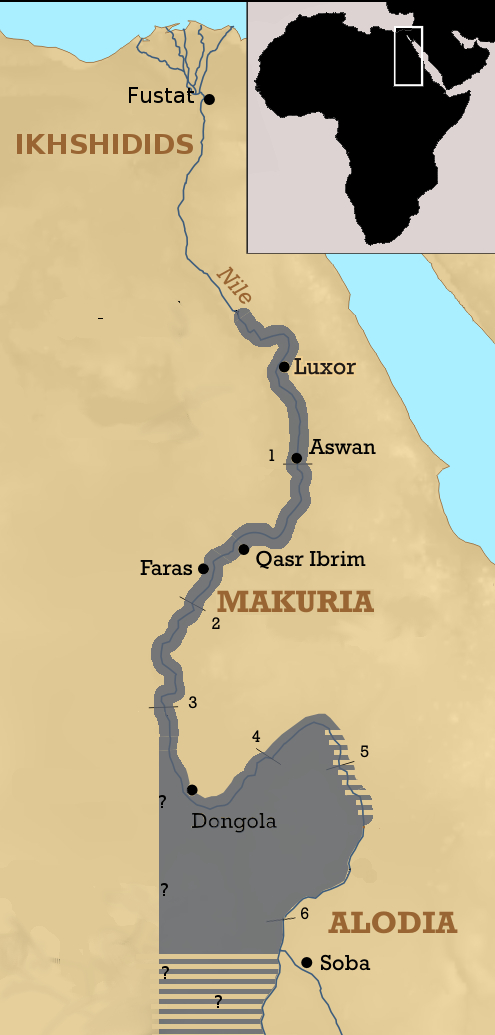
I think the Mizraimite Ludim were the people of the region known in late Antiquity and medieval times as Alodia which name can be traced back to Ancient Kushite inscriptions as Alut.  Here are some maps of late antiquity Christian Nubia.
As an extra Biblical Note, I think Makuria is also the land Herodotus knew as Macrobia.

Since I mentioned Phut, Mizraim's brother, above I might as well deal with the documentation on him.

Pliny the Elder Nat. Hist. 5.1 and Ptolemy Geog. iv.1.3 both place the river Phuth on the west side of Mauretania (modern Morocco). Ptolemy also mentions a city Putea in Libya (iv.3.39).  This might be the same river mentioned by other authors under other names being connected to the Atlas Mountains.

Other references seem to place Phut closer to Egypt.  Putaya was the name of the Persian Satrapy of Libya, Nebuchadnezzar refereed to the Cyrenians as the "Putu Yavan" (Ionians in Libya).  I think this location closer to Egypt is probably where Phut first settled, then they migrated further west and their original settlement was taken over by the Casluhim and Lehubim/Lubim.

The notion that Phut and Lubim became different names for the same place is attested by Josephus in AotJ Book 1:6/2.

Egypt as a major Empire and center of Trade located on the crossroads of two continents had a very diverse population. So none of this means other grandsons of Noah didn't also contribute to ancient Egypt.  I still think the Origins of Osiris and Horus could partly lie in the Horite genealogy of Genesis 36 (thus descent from the Hitties and Hivites), as well as that Seb/Keb/Geb could be partly based on one of the three Sebs who were sons of Cush.

The Philistines.

I feel like ranting on this subject a bit.  We now know that the City of Gaza is indeed the oldest of the Philistine Pentapolis, Biblically it's the only one mentioned in Genesis.  We also know the oldest settlement there was an Egyptian Fort built back in the Early Bronze Age.  We also know it was essentially Egypt's regional capital in Canaan during the 18th and Nineteenth Dynasties.  Meaning archeology tells us exactly why The Bible depicted them as essentially Egyptian Colonists.

But the notion that the Philistines weren't in that region till Rameses III, and that they came from the Aegean, continues to pervade because Egyptian records don't use that name till then.  I think Philistines/Peleset was never what they called themselves but always a mostly derogatory term, related to a Hebrew verb used of wallowing in the dust/dirt.  I think the time of Rameses III is simply when these colonials decided to claim independence from their mother empire like the Yankees in 1776, and so only then did the Pharaoh also use this insulting term for them.

But most importantly the Peleset were NOT Sea Peoples in any 20th Dynasty records, scholars like to group them in with the "peoples of the Sea" and "peoples of the Isles" they allied themselves with, but Rameses III did NOT apply that term to the Peleset or the Tjekker.  

If the Philistines post Rameses III seem in their language and fashion and art similar to the Mycenean Greeks, it's because of cultural exchange via the Denyen/Danoi/Danaans they were allied with, not because they originally came from there.

I also read an English Translation of the Peshita where Genesis 10:13-14 says that out of Casluhim came both the Philistines and Caphtorim.

The Bible says the Philistines main patron Deity was Dagan, this is somewhat a mystery since Dagan is in the standard Canaanite pantheon but not a major player. And Archeologists haven't found the evidence for this, partly because they only count anything as Philistine starting with Rameses III.  We know the Egyptians tended to syncretize storm gods like Baal/Hadad with Set.  So Dagan might have been the Canaanite deity who was identified with Osiris or maybe Amon.

Thursday, November 14, 2019

Tarshish is Tarsus of Cilicia.

It has long been popular to argue for more exotic or distant identifications for Tarshish, including by myself in the past.  But Josephus said Tarshish was Tarsus, and this modern article backs up that identification convincingly.

Tarshish (Josephus' Tarsus Reconsidered)
http://www.bibleorigins.net/tarshishtarsus.html

There is one detail in that I can't agree with, and that's arguing for a late dating of Genesis based on pre Esarhaddon Assyrian Inscriptions rendering Tarsus was Tarzi.  It could be Tarzi was a mistaken Assyrian form corrected by later Assyrians who knew more directly what they called themselves, or the Tarzi inscriptions could be scribal errors.  There is no need to question the reliability of Genesis over this.

Those are all very technical and scholarly reasons for that identification.  What I want to speculate on now is how it could theologically serve the Meta-narrative of The Bible to connect Old Testament Tarshish to New Testament Tarsus.

Like OT Tarshish it's never a location the narrative visits directly (same with Cilicia as a whole), the few times it seems like Acts is about to go there it then skips forward.

NT Tarsus is only relevant for being the hometown of Saul later known as Paul.  Before he's ever mentioned by name he's probably one of the Cilicians refereed to in Acts 6.

We know from Extra Biblical sources that Tarsus of Cilicia was a port city associated with sea trade and thus with ships, but Biblically the New Testament never directly mentions that.  However Paul does spend a lot of time on ships, some travel by ship was a part of all four missionary journeys, most famously his ship wreck on Malta.

Tarshish was a grandson of Japheth, but the name is also duplicated as a Benjamite in 1 Chronicles 7:10.  I think it's possible the Chronicler is more using this name as a stand in for a Benjamite clan that would in the future live in Cilicia, possibly as a result of the slave trade alluded to in Joel 3.

Paul who was a Benjamite can be viewed as playing a role in how the Genesis 9 eschatological relationship between Japheth and Shem was fulfilled.

A number of Prophecies also speak of Ships of Tarshish playing a role in how exiled Israelites are brought back to the promised land.  In some views that too is arguably fulfilled partly by the work of Paul.